Radio Brisvaani

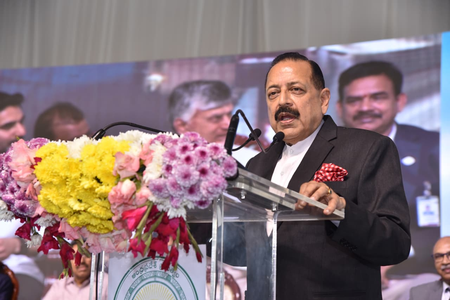
New Delhi, Feb 8 (IANS) India today stands among a select group of nations with a dedicated National Quantum Mission, targeting 1,000 Qubits and 2,000-km Quantum Communication Network to transform defence, cybersecurity and healthcare, Union Minister Dr Jitendra Singh said on Sunday.
With an allocation of approximately Rs 6,000 crore, the Mission spans 43 institutions across 17 states and 2 Union Territories, organised through four thematic hubs focusing on Quantum Computing, Quantum Communication, Quantum Sensing and Metrology, and Quantum Materials and Devices.
“The national objectives include developing quantum computers with up to 1,000 physical qubits within eight years, establishing secure ground-to-ground quantum communication networks, enabling long-distance quantum communication, and achieving inter-city Quantum Key Distribution across 2,000 kilometres,” said the minister as he addressed the foundation ceremony of ‘Amaravati Quantum Valley’ in Andhra Pradesh.
Describing quantum technology as a strategic necessity rather than an option, the minister said India has no choice but to lead in this domain if it seeks to secure its communication systems, defence architecture, healthcare innovation, and global technological standing in the coming decades.
The foundation ceremony was attended by Chief Minister N. Chandrababu Naidu, State Minister for IT, Electronics and Education, Nara Lokesh, Principal Scientific Adviser to the Government, Professor Ajay Kumar Sood and other senior officials.
Recalling his early exposure to the Chief Minister’s technology-driven governance during the first term in Hyderabad’s Hi-Tech City, Dr Singh said the rapid progress seen in Andhra Pradesh over the past year reflects the true spirit of cooperative federalism and what Prime Minister Narendra Modi describes as the “double-engine” approach — alignment between the Centre and the State.
Referring to his visit to Visakhapatnam last week, the Minister cited the long-pending National Centre for Ocean Sciences project, conceived in 2006 and stalled for nearly two decades, which was completed within months after the present state government assumed office.
—IANS
na/