Radio Brisvaani

New Delhi, Dec 11 (IANS) The Indian Railways has planned to progressively meet its electric power requirement for traction purposes through renewable energy sources with a combination of solar, wind and other renewable sources based on strategic power procurement planning, thereby reducing its carbon emissions, Railways Minister Ashwini Vaishnaw informed the Parliament on Thursday.
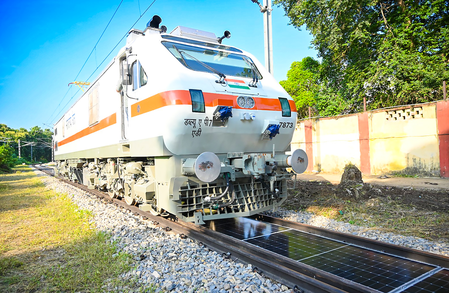
In a written reply to a question in the Lok Sabha, Vaishnaw said that till November 2025, about 812 megawatt (MW) of solar plants and about 93 MW of wind power plants have been commissioned, which are meeting the traction requirements of the railways. Further, 100 MW of renewable power under the Round the Clock (RTC) mode tied up from the Solar Energy Corporation of India (SECI) has also started flowing for traction purposes.
In addition to this, 1,500 MW of renewable capacity under the RTC mode has been tied up to meet the traction power requirement. This is a hybrid solution consisting of solar, wind, and storage components.
During the year 2023-24, the expenditure on traction of the railways was Rs 29,614 crore, which included all types of traction.
The minister further stated that with the adoption of modern technology and electrification of the rail network, there has been a reduction in the use of coal-based and diesel engines.
Electrification of the Indian Railways network has been taken up in mission mode. So far, about 99.2 per cent of the Broad Gauge (BG) network has been electrified. The electrification of the remaining network has been taken up. Electrification carried out during 2014-25 was as much as 46,900 route km, which is more than twice the mere 21,801 route km that was electrified in several years before 2014, the minister said.
He further stated that Indian Railways is now manufacturing and commissioning state of the art three-phase IGBT technology-based locomotives. These locomotives have regenerative features and are, therefore, able to regenerate part of the energy consumed during braking and are, therefore, more energy efficient.
The coal-fired steam engines are being utilised on UNESCO-accredited mountain railways, seasonal steam-hauled trains and in chartered trains in association with the ICRTC. Their utilisation is on railway routes with heritage values.
Vaishnaw also highlighted that Indian Railways has also taken up a state-of-the-art project for running its first hydrogen train, on a pilot basis, as per specifications framed by the Research, Design & Standards Organisation (RDSO) to demonstrate the use of hydrogen-powered train technology in railways. The project establishes a commitment of Indian Railways towards advancement in alternative energy-powered train travel, thereby ensuring a cleaner and greener future for the country’s transportation sector.
As part of its strategy to achieve the target of Net Zero Carbon Emitter by 2030, the railways has planned to progressively meet its electric power requirement through renewable energy sources with a combination of solar, wind and other renewable sources based on strategic power procurement planning, thereby reducing its carbon emissions, the minister added.
–IANS
sps/vd