Radio Brisvaani

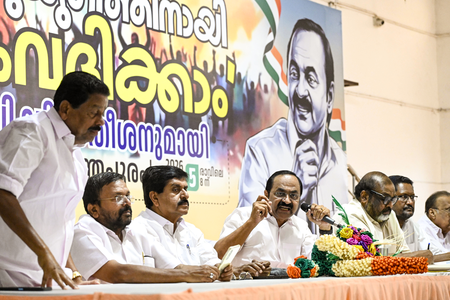
Thiruvananthapuram, March 7 (IANS) Leader of Opposition in the Assembly, V.D. Satheesan has emerged as the most preferred chief ministerial candidate in Kerala ahead of the 2026 Assembly elections, according to a pre-poll study by an independent public opinion platform, Vote Vibe.
This is a clear sign of shifting political sentiment as Chief Minister Pinarayi Vijayan seeks an unprecedented third consecutive term at the helm of the state.
The survey places Satheesan at the top of the leadership preference chart with 25.2 per cent support, narrowly ahead of Vijayan at 21.5 per cent.
While the margin is modest, political observers note that an Opposition leader outpolling a two-term incumbent reflects a degree of voter fatigue and a growing appetite for leadership change.
Despite this, the broader contest between the two alliances remains finely balanced.
The combined leadership preference for the United Democratic Front (UDF) stands at 38 per cent, only marginally behind the Left Democratic Front’s (LDF) 39.1 per cent, underscoring how tight the electoral battle could become.
The survey highlights what analysts describe as the LDF’s central paradox, strong public approval for welfare programmes alongside declining trust in governance.
Around 44 per cent of respondents expressed satisfaction with flagship initiatives such as LIFE Mission housing, KASP and Kudumbashree.
However, almost the same proportion 44.2 per cent said they believe the corruption allegations against the government are true.
Economic pressures appear to be shaping voter sentiment.
Unemployment emerged as the top issue for 23.2 per cent of respondents, followed by price rise at 18.8 per cent and corruption at 11.4 per cent.
Together, these concerns account for over half of voter anxieties, indicating that anti-incumbency may be driven more by economic stress than by ideological shifts.
The survey by the independent public opinion platform also points to the disruptive role of the Bharatiya Janata Party (BJP) in the State’s electoral arithmetic.
While 27.7 per cent of respondents believe BJP growth hurts the LDF more than the UDF (18.7 per cent), a significant 26.8 per cent say it damages both fronts.
This suggests the party may act more as a vote splitter than a decisive kingmaker.
Attempts by rival fronts to shape public narratives have also yielded inconclusive results.
Claims of a tacit CPM–BJP understanding produced a near three-way split in opinion, with 33.6 per cent agreeing, 32.3 per cent disagreeing and 34.1 per cent undecided.
Similarly, the allegation that the Indian Union Muslim League would act as a “backseat driver” in a UDF government has failed to gain traction among voters.
Demographic trends offer further insight into the evolving contest.
Women appear significantly more satisfied with welfare programmes than men, suggesting social schemes remain a key support base for the LDF.
Younger voters, particularly those between 18 and 24, show a strong focus on unemployment, while the 25–34 age group emerges as the most critical of the government on corruption.
Community alignments also remain significant.
Scheduled Caste voters continue to show relatively stronger support for the LDF, while Muslim and Christian voters remain firmly aligned with the UDF coalition.
Perhaps the most crucial finding is the size of the undecided electorate.
Across several questions, more than 30 per cent of respondents remained neutral or unwilling to state a preference, a persuadable bloc that could determine the outcome in closely fought constituencies.
The study concludes that Kerala enters the 2026 election with two competing political narratives.
The LDF retains the advantage of welfare credibility and organisational strength, while the UDF appears to have gained momentum through leadership perception and issue advantage.
With a large undecided electorate and multiple cross-currents shaping voter behaviour, the contest remains wide open, setting the stage for what could be one of Kerala’s closest electoral battles in recent memory.
–IANS
sg/rad