Radio Brisvaani

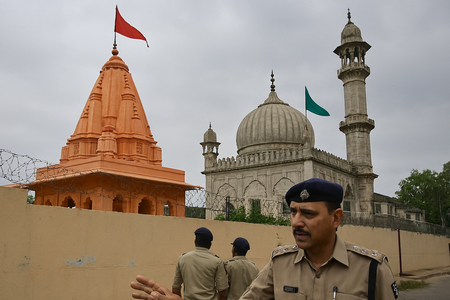
Dhar, Jan 22 (IANS) As a large number of people from the Hindu and Muslim communities are expected to visit the disputed Bhojshala Temple-Kamal Maula Mosque complex to offer religious prayers on January 23, the Dhar district administration has issued prohibitory orders, imposing Section 163 of the Bharatiya Nagarik Suraksha Sanhita (BNS).
A multi-layer security system involving more than 8,000 police personnel and the Rapid Action Force (RAF) has been deployed, and the administration has also declared a no-fly zone within a 300-metre radius of the Bhojshala complex, where Basant Panchami will be celebrated on Friday.
All aerial activity, including drones, UAVs, paragliding, hot air balloons, or any flying object, is strictly banned.
Dhar district collector Priyank Garg said on Thursday that the district administration and police have prepared fully to ensure better law and order.
“We are fully prepared for the Basant Panchami festival, which is falling on Friday. Our primary objective is to ensure better law and order,” Garg said, briefing the media on Thursday.
Garg said that the district administration is committed to complying with the Supreme Court’s order. He also appealed to media organisations and social media owners to refrain from any kind of interpretation on the Supreme Court’s verdict regarding the permission of Hindus and Muslims for offering religious prayers at the site.
The collector issued a stern warning that any content inciting religious hatred, whether through newspapers, electronic media, social media platforms like WhatsApp or Facebook, will invite strict action under the Bharatiya Nyaya Samhita and the IT Act.
“Media persons are advised to refrain from interpretation of the SC’s verdict. Interpretation may disturb law and order. District administration will share the details about every development with media persons,” Garg said.
He stated that district administration has started preparations for the day (Basant Panchami) for the last few weeks, and several meetings were organised with people from all communities for discussion. So far, the administration has conducted 31 Mohalla Committee meetings and 21 meetings with members of the Muslim community, aimed at defusing tensions and building trust, he added.
Speaking further on the security arrangement, Garg stated that apart from police personnel or RAF, technology-driven security architecture has been rolled out in the surroundings of the disputed historical building. Artificial Intelligence, LiDAR, and 3D city mapping are now at the heart of Dhar’s law-and-order strategy, transforming the town into a digitally monitored zone.
He shared that a central control room has been set up from where police will conduct live monitoring across the city. Over 20 AI-enabled drones will fly at regular intervals, feeding real-time data on crowd density.
“Over a dozen SPs, 25 Additional Superintendents of Police, and 67 Deputy SPs have been deployed for security. In addition, 933 women police personnel and eight RAF platoons have been deployed. Another 1,500 to 2,000 police personnel are on standby to reinforce sensitive areas if required,” he added.
The Supreme Court hearing the matter on Thursday allowed Hindu prayers from sunrise to sunset on Basant Panchami (on Friday) and permitted Muslims to offer namaz from 1 pm to 3 pm on the day at the disputed site.
A bench comprising Chief Justice of India Surya Kant and Justices Joymalya Bagchi and Vipul M Pancholi appealed to both sides to observe mutual respect and cooperate with the state and district administration for the maintenance of law and order.
The reason behind the dispute is that Hindus consider Bhojshala, an Archaeological Survey of India (ASI)-protected 11th-century monument, to be a temple dedicated to Vagdevi (Goddess Saraswati), while the Muslim community calls it Kamal Maula mosque.
Under an arrangement made by the ASI on April 7, 2003, Hindus perform puja on the Bhojshala premises on Tuesdays, and Muslims offer ‘namaz’ in the complex on Fridays.
–IANS
pd/dan