Radio Brisvaani

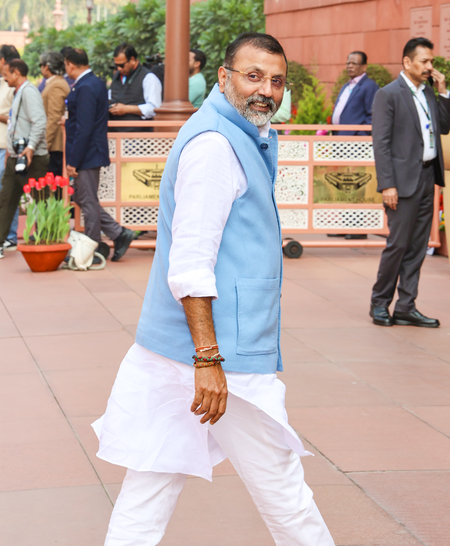
New Delhi, Feb 14 (IANS) Following his decision of moving a substantive motion against Leader of Opposition (LoP) in the Lok Sabha, Rahul Gandhi, BJP MP Nishikant Dubey on Saturday drew a direct parallel with December 1978, when a same motion adopted by the House resulted in the disqualification of former Prime Minister late Indira Gandhi and her subsequent imprisonment over findings of electoral and privilege-related misconduct.
A substantive motion is an independent and self-contained proposal placed before a Legislative House for its approval, framed to convey a clear decision or opinion of the House. Once admitted and formally moved, it triggers a debate and must be put to a vote.
Dubey has now moved a similar substantive motion against LoP Rahul Gandhi, alleging breach of privilege and seeking cancellation of his Lok Sabha membership along with disqualification from contesting future elections.
An image shared in Dubey’s post on X includes extracts from the 1978 parliamentary record.
“In December 1978, when, on the basis of a similar Substantive motion, Rahul Gandhi ji’s grandmother, Prime Minister Indira Gandhi ji, lost her membership and was sent straight to jail,” he captioned the image.
The 1978 case stemmed from a substantive motion introduced in the Lok Sabha on November 22, 1978, following a report by the Committee of Privileges that found Indira Gandhi guilty of breach of privilege and contempt of the House.
The findings related to actions taken during the Emergency in 1975, specifically accusations that she had caused “obstruction, intimidation, harassment and institution of false cases” against four government officials who were gathering information about her son Sanjay Gandhi’s Maruti project.
After an intense debate, a resolution moved by then-Prime Minister Morarji Desai was passed on December 19, 1978. The adoption of the motion led to Indira Gandhi’s expulsion from the Lok Sabha and her incarceration in Tihar Jail for the remainder of the parliamentary session.
The expulsion, however, did not remain permanent. On May 7, 1981, the 7th Lok Sabha revoked the earlier decision after she returned to power.
Earlier on Thursday, Dubey said that he had initiated a substantive motion against LoP Gandhi, accusing him of being “hand in glove” with “anti-national” forces.
The move follows a stormy session in the Lok Sabha a day earlier, when LoP Gandhi launched a sharp attack on the Centre over the India-US trade deal. He accused it of surrendering India and its people before foreign powers and alleged that it had effectively “sold Bharat Mata.”
His remarks triggered loud protests from treasury bench members, who objected to what they described as “unparliamentary” expressions and demanded that the statements be expunged from the official record.
Subsequently, BJP MPs announced their intention to move a privilege motion against the Leader of Opposition, accusing him of “misleading” the House with “baseless and malicious” allegations.
The Congress party rejected the charge, maintaining that no breach of parliamentary norms had occurred. Party leaders argued that the LoP was fully within his rights to criticise the government and the Prime Minister, particularly over what they termed “surrendering” India’s energy and farmers’ interests in the India–US trade arrangement.
Later on Thursday evening, Union Parliamentary Affairs Minister Kiren Rijiju confirmed that the government had, for the moment, set aside its own proposed motion against LoP Gandhi.
He added that since a private member’s substantive motion had already been introduced by Nishikant Dubey, the government had opted to temporarily defer its own initiative.
–IANS
sd/rad