Radio Brisvaani

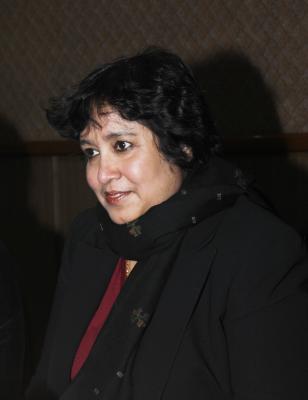
New Delhi, Jan 6 (IANS) Are the Left parties in India secular and liberal as they are usually considered? No, claims Bangladesh’s exiled author Taslima Nasreen in a recent Facebook post.
She points out the dichotomy among communists being “very active against jihadists in Bangladesh” today having once called her book on radical fundamentalism as lies, finally driving her out of Kolkata.
“Some blind (for their organisation) communist factions in West Bengal are spitting venom against me. They want to show that CPM people are very active against jihadists in Bangladesh. Really?” the writer posted in Bengali on her Facebook handle on Tuesday.
CPM, or CPI(M) refers to the principal constituent of the Left Front – the Communist Party of India (Marxist). She also questioned the party being quiet when through the decades, “Islamic fundamentalists have been persecuting Hindus in Bangladesh, forcing them to leave the country”.
Terming her expulsion from Bangladesh as “unjust”, Taslima wanted to know if there have been any protests “in the progressive city of Kolkata” when “terrorists have hacked bloggers to death; freethinkers have been forced to leave the country one by one”.
With a bounty on her head, she first headed for Sweden, but later settled in Kolkata which she found “closer to home”.
She holds Swedish citizenship but resides in India on renewable permits. But in 2007, violent protests broke out against her books, and she had to flee West Bengal too. After a brief period of uncertainty, she has since been in Delhi, under government protection.
“Throughout the ’90s, CPM-affiliated newspapers published numerous articles against ‘Lajja (Shame)’. They propagated that I had lied in Lajja, claiming there was no persecution of Hindus in Bangladesh. Hindus are very good, living in peace and happiness, and Muslims are very liberal, non-communal. And yet, I should supposedly be ashamed of writing with some ill intent,” wrote the activist-writer on gender equality and freedom of speech.
Lajja, published in 1993, depicted the persecution of Hindus in Bangladesh after the Babri Masjid demolition in India.
The novel was banned in Bangladesh for allegedly inciting communal disharmony. It has since been translated into about 25 languages worldwide, according to Taslima.
“Astonishingly, when they stand by the minorities in their country, it is considered generosity and liberalism, but when I stand by the minorities in my country, it is considered ill-intent?” she posted.
She also refers to the 2003 ban on the third volume of her autobiography ‘Dwikhondito (split in two)’ in West Bengal, then under the Left Front government led by Buddhadeb Bhattacharya.
“In Dwikhondito I wrote about the resistance of free thinkers against the fundamentalist forces in Bangladesh. I protested against changing the secular constitution to make Islam the state religion,” claims Taslima.
“Yet, it was banned,” she laments. “Many partisan intellectuals wrote extensively against the book. APDR (Association for Protection of Democratic Rights, which claims to be a part of the countrywide civil and human rights movement) even filed a case against the ban of the book. During the hearing in the High Court, the government’s lawyers could not provide a single argument in favour of the ban. The Calcutta High Court lifted the ban on the book,” she points out.
“When India’s minority Muslims are persecuted, protest is naturally appropriate – I do it too. But I was deeply hurt to see the CPM stand by misogynistic Muslim laws. They are even against the Uniform Civil Code, which is based on equal rights. They support Hindu women gaining equal rights, but they do not support Muslim women gaining the same,” points out the author.
“Even if there is barbarism in religion, if there is misogyny, still they (CPM) want them to stay drowned in that barbarism and misogyny. If they wanted to civilize Muslims, they would not defend Islam under the guise of trickery and deceit,” asserts Taslima.
–IANS
jb/rad