Radio Brisvaani

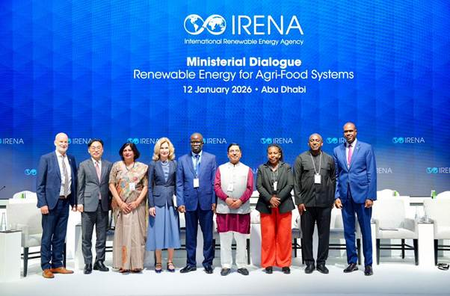
New Delhi, Jan 12 (IANS) Union Minister for New and Renewable Energy Pralhad Joshi on Monday underscored India’s commitment to integrating renewable energy with agriculture and food systems to enhance energy security, climate resilience and rural livelihoods.
The minister was addressing the inter-ministerial dialogue on Scaling Renewable Energy in Agrifood Systems, jointly convened by the International Renewable Energy Agency (IRENA) and the Food and Agriculture Organisation (FAO) in Abu Dhabi.
Joshi referred to the PM-KUSUM scheme, which integrates solar energy into agriculture through standalone solar pumps, solarisation of grid-connected pumps and decentralised solar power plants.
He said that as of late 2025, nearly one million standalone solar pumps have been installed, and over 1.1 million grid-connected pumps solarised, contributing more than 10,200 MW of installed capacity.
The scheme, he added, has reduced dependence on diesel, stabilised irrigation costs, lowered emissions and shifted fiscal support from recurring subsidies to long-term asset-based investments, according to an official statement.
Joshi stated that when India speaks on global platforms, it represents nearly one-sixth of humanity and some of the world’s largest food security programmes, alongside one of the fastest-growing renewable energy markets.
Emphasising India’s agrarian ethos, he noted that farmers, revered as Annadata, are increasingly becoming Urjadata, providers of both food and clean energy, through the expansion of distributed renewable energy, the statement said.
The Minister highlighted that renewable energy offers a unifying solution to the multidimensional global challenge of delivering energy access, climate action, agricultural productivity and rural livelihoods simultaneously.
On unlocking private investment, Joshi noted that initiatives such as surplus solar power sale by farmers, the National Bioenergy Programme for converting agricultural residues into energy, and the PM Surya Ghar Muft Bijli Yojana for rooftop solar have created new income streams, reduced imports and strengthened rural energy security.
The Union Minister announced that India is preparing to roll out PM-KUSUM 2.0, with a renewed focus on decentralised solar solutions and agri-photovoltaics (agri-PV), which allow agriculture and solar power generation to coexist. Well-designed agri-PV systems, he said, can maintain or enhance crop yields, moderate micro-climates, generate clean electricity, and diversify farmer incomes.
Concluding his address, the minister reaffirmed India’s readiness to deepen partnerships and scale solutions, noting that with abundant sunshine and over 146 million small landholdings, the country is well positioned to emerge as a global leader in renewable energy-enabled agrifood systems.
On the sidelines of the 16th Assembly of IRENA, Joshi held a forward-looking meeting with. Elín Rós, Director General, International Development Cooperation, Ministry for Foreign Affairs of Iceland. The discussions focused on strengthening technical cooperation to scale geothermal energy deployment in India as part of its clean energy transition.
In another key bilateral engagement, the Indian minister held a constructive meeting with. Ditte Juul Jorgenson, Director-General for Energy at the European Commission. The discussions reviewed the steady deepening of the India–European Union Clean Energy and Climate Partnership, with a shared emphasis on delivering tangible outcomes on the ground.
He also held a productive discussion with Mohammed Hassan Al Suwaidi, Minister of Investment of the United Arab Emirates, on strengthening India–UAE cooperation in renewable energy and clean infrastructure.
–IANS
sps/dan