Radio Brisvaani

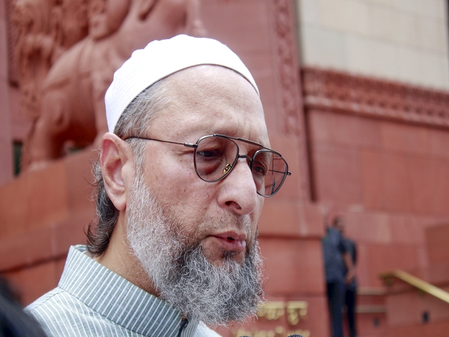
New Delhi, Dec 13 (IANS) The All India Majlis-e-Ittehadul Muslimeen (AIMIM), led by five-time Lok Sabha MP from Hyderabad Asaduddin Owaisi, has again set its focus on the Muslim dominated constituencies in West Bengal after the Bihar mandate.
In 2020-21, following the party’s five-seat toehold in the 243-member Bihar Assembly, AIMIM leader Asaduddin Owaisi had turned his attention towards West Bengal election.
But he later learnt that Hyderabadi Biriyani, a delicacy from the region where his party is based, can not be served in a state that favours the Avadhi variety.
Thus, he sought out a local chef who could tweak it to suit local palate. The AIMIM leadership approached Pirzada Abbas Siddiqui, founder of the just-then-launched India Secular Front (ISF).
The meeting went well, but the Pirzada was intent on allying with the Congress and Left Front against the ruling Trinamool Congress in West Bengal.
This grouping was not too hopeful of AIMIM finding favour among Bengali Muslims whose language and culture were different.
Owaisi decided to pull back; and in the days that followed, his party witnessed an erosion in both Bihar and West Bengal.
But now, after a Bihar poll redux, Owaisi may have a new alliance in sight in the adjacent state.
The recently suspended Trinamool MLA Humayun Kabir has positioned himself as a new minority leader in West Bengal.
His contentious “Babri Masjid” project has catapulted him into national recognition.
He claims strong grassroots support and has already declared his political plans. He will soon launch a political party to contest 135 of West Bengal’s 294 seats in next year’s Assembly election.
His strategy centres on assertive minority mobilisation and symbolic projects like the mosque foundation-laying event to consolidate a distinct constituency base.
Reports indicate substantial donations running into crores and outreach beyond the state, which Kabir may find convenient through the AIMIM.
Both follow identity‑based minority politics, driven by a singular personality with religious overtones; yet, there may be compatibility differences, mainly on strategy and local issues.
Kabir is a rising regional actor with clear ambitions to be a “kingmaker” where he has predicted that no political party will come close to the halfway mark in the Assembly.
As things stand now, tactical seat adjustment with AIMIM seems a possibility in a few seats, but a full statewide tie‑up is still uncertain.
At this time, Kabir appears to be seeking allies, and the AIMIM state unit is reportedly open, but the latter’s central leadership still exhibits some caution.
Meanwhile, the AIMIM, upbeat from another, similar, Bihar mandate, is building up its base in Murshidabad district, where Muslim population is said to be some 70 per cent of the demography.
In adjacent Malda, a district with over 50 per cent Muslim population, Owaisi’s party is hunting for new offices and office-bearers. In the case of an electoral fragmentation, with at least three Muslim‑centred outfits – led by Owaisi, Siddiqui, and Kabir – along with the Trinamool, Congress, and the Left coalition vying for the spoils, anti‑BJP votes will be widely split in several constituencies.
Anticipating that, as some on-ground reports suggest, Kabir may try to woo the ISF, Congress and the Left leadership to agree to a seat sharing equation — at least in crucial seats — so that he can evolve as the “kingmaker” he aspires to be.
However, he should know that the leaders he has to indulge are more experienced and astute than he probably assumes.
One thing is certain, West Bengal’s Assembly election 2026 will witness identity politics and polarisation to an extent that the sundry Bengali ‘bhadralok’ may not have imagined. And that may lead to the ugly shadow of hatred and communal tensions, inviting legal and administrative pushback, and more chaos that the state can do without.
–IANS
jb/pgh