Radio Brisvaani

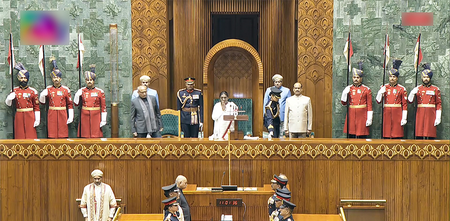
Bhopal, Jan 28 (IANS) President Droupadi Murmu’s address to the joint session of Parliament on Wednesday was marked by strong assertions of India’s security achievements and the government’s success in tackling internal and external threats.
Setting the tone for the Budget session, she lauded the elimination of Maoist influence across much of the country and praised the Indian Armed Forces for their decisive response to terrorism through Operation Sindoor, launched in the aftermath of the Pahalgam terror attack in 2025.
President Murmu invoked the words of Guru Tegh Bahadur– “bhay kahun ko deit nehn nehn bhay manat aan (we should neither scare anyone nor be scared of anyone)” — reminding the nation that India’s strength lies in its fearless spirit, one that neither intimidates others nor succumbs to fear.
With this guiding principle, she said, India has ensured its security and demonstrated to the world its resolve in defending sovereignty.
Operation Sindoor, she declared, was a turning point that showcased the valour of the Armed Forces. “With its own resources, our country destroyed terror hotbeds,” she told Parliament, underscoring that India did not rely on external support but acted independently to safeguard its people.
The President also highlighted the government’s strategic decision to keep the Indus Water Treaty in abeyance as part of its fight against terrorism. This move, she suggested, was emblematic of India’s willingness to recalibrate long-standing agreements when national security is at stake.
By linking water diplomacy to counter-terrorism, President Murmu conveyed that India’s approach is both comprehensive and uncompromising.
Turning to internal security, President Murmu spoke of the government’s achievements in curbing Maoist insurgency, which for decades had cast a shadow over large parts of the country.
“For years, there was fear and distrust in 126 districts of the country. Maoist ideology pushed the future of several generations into darkness,” she said, recalling the scale of the challenge. Today, however, she noted that the problem has been reduced to just eight districts, a remarkable contraction that reflects the success of sustained counter-insurgency measures, development initiatives, and rehabilitation programmes.
The President revealed that about 2,000 individuals with links to Maoist groups have surrendered in the past year alone, a development she described as a testament to the government’s dual strategy of firmness and reconciliation.
By combining security operations with efforts to bring former insurgents back into the mainstream, India has not only weakened Maoist networks but also offered a path of dignity and opportunity to those who once lived on the margins.
President Murmu’s speech carried a tone of triumph but also of caution, reminding lawmakers that the fight against extremism requires vigilance and unity.
She emphasised that India’s progress in eliminating Maoism and confronting terrorism is not merely about military victories but about restoring trust, ensuring justice, and securing the future of communities that had long been trapped in cycles of violence.
Her remarks on Operation Sindoor were particularly striking, as she framed the military campaign not just as a tactical success but as a moral statement.
By acting decisively after the Pahalgam attack, India demonstrated that it would not tolerate aggression and that its Armed Forces are capable of dismantling terror infrastructure with precision and courage. The operation, she said, has become a symbol of India’s self-reliance in defence and its determination to protect citizens from cross-border threats.
President Murmu’s invocation of Guru Tegh Bahadur’s words added a philosophical dimension to her speech, linking contemporary security challenges to India’s historical ethos of courage and righteousness. In doing so, she sought to remind Parliament and the nation that India’s strength lies not only in its military might but also in its moral clarity.
The President’s address, while focused on security, also carried broader implications for India’s development narrative. By highlighting the reduction of Maoist influence and the surrender of thousands of insurgents, she suggested that peace and stability are prerequisites for growth.
The government’s success in these areas, she argued, has opened the door for economic development, social justice, and the empowerment of communities that were once isolated by conflict.
As the Budget Session commenced, President Murmu’s words set a backdrop of resilience and confidence. Her emphasis on eliminating Maoism, confronting terrorism, and asserting India’s sovereignty through measures like Operation Sindoor and the suspension of the Indus Water Treaty underscored the government’s claim of having secured the nation against both internal and external threats.
In a speech that blended history, philosophy, and contemporary policy, President Murmu presented India as a nation that has faced its challenges head-on and emerged stronger.
–IANS
sktr/dpb