Radio Brisvaani

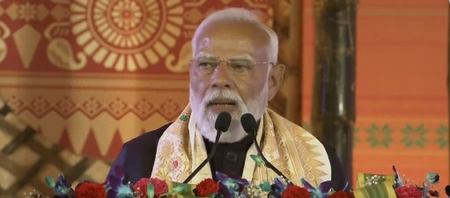
Guwahati, Jan 17 (IANS) Prime Minister Narendra Modi said on Saturday that it has been his privilege to witness Assam’s culture and closely observe the traditions of the Bodo community as he attended the Bagurumba Dwhou, a historic cultural event celebrating the rich heritage of the Bodo community at Sarusajai Stadium here.
Highlighting that no Prime Minister has visited Assam as frequently as he has, PM Modi emphasised his constant wish that Assam’s art and culture receive a larger platform and gain recognition across the nation and the world through grand celebrations.
He noted that continuous efforts have been made in this direction, citing large-scale Bihu festivities, the expression of Jhumoir Binondini, the grand Bodo Mahotsav held in New Delhi one-and-a-quarter years ago, and other cultural programmes.
The Prime Minister underlined that he never misses an opportunity to experience the unique joy of Assam’s art and culture.
He said that once again, the Bagurumba festival is being organised, describing it as a vibrant celebration of Bodo identity and a tribute to Assam’s heritage.
Prime Minister Modi extended his best wishes and congratulations to all those associated with the event, especially the artists.
The Prime Minister said that Bagurumba Dwhou is not merely a festival but a medium to honour the great Bodo tradition and to remember the eminent personalities of the Bodo society.
He recalled names such as Bodofa Upendra Nath Brahma, Gurudev Kalicharan Brahma, Rupnath Brahma, Satish Chandra Basumatary, Moradam Brahma, and Kanakeswar Narzary, noting their contributions to social reform, cultural renaissance, and political awakening.
The Prime Minister paid tributes to all such tall leaders of the Bodo community.
He emphasised that the BJP considers Assam’s culture as the pride of the entire nation, and that India’s history is incomplete without the Northeastern state’s past and heritage.
PM Modi highlighted that under the current BJP government in the state, grand festivals like Bagurumba Dwhou are organised, Bihu has been given national recognition, and efforts have led to Charaideo Moidam being included in UNESCO’s World Heritage list.
He remarked that the Assamese language has been accorded classical status, and the Bodo language has been recognised as an associate official language of Assam, with a separate directorate established to strengthen education in Bodo language.
PM Modi underlined that due to this commitment, Bathou Dharma has been accorded full respect and recognition, and Bathou Puja has been declared a state holiday.
He said that it is under the current BJP government that a grand statue of warrior Lachit Borphukan has been installed and the statue of Bodofa Upendra Nath Brahma unveiled.
He added that the traditions of devotion and social harmony of Srimanta Sankardeva and the art and consciousness of Jyoti Prasad Agarwala are honoured as part of Assam’s heritage.
The Prime Minister noted that it is Jyoti Prasad Agarwalas death anniversary today and offered his tribute.
Expressing his emotions on visiting Assam, PM Modi said he feels deeply moved seeing how far the state has progressed.
He recalled that there was a time when bloodshed was frequent, but today the colours of culture shine; a time when gunfire echoed, but now the melodious sounds of Kham and Sifung prevail; a time when curfew brought silence, but now music resonates; a time of unrest and instability, but now Bagurumba’s captivating performances are being held.
PM Modi stressed that such a grand celebration is not only Assam’s achievement but India’s achievement, and every citizen of the country is proud of Assam’s transformation.
The Prime Minister expressed satisfaction that the people of Assam and his Bodo brothers and sisters placed their trust in him.
He remarked that the BJP governments at the Centre and state were entrusted with the responsibility of peace and development, and with the blessings of the people, that responsibility has been fulfilled.
PM Modi highlighted that the 2020 Bodo Peace Accord brought an end to decades of conflict, restored trust, and enabled thousands of youth to abandon violence and join the mainstream.
He noted: “After the accord, new opportunities in education and development emerged in the Bodo region, and peace became a part of everyday life, with the people’s efforts playing the most significant role.”
–IANS
tdr/khz