Radio Brisvaani

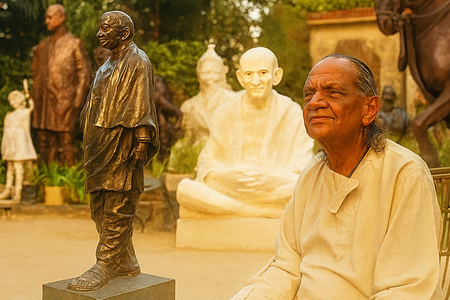
New Delhi, Dec 18 (IANS) Renowned sculptor Ram Vanji Sutar, whose works shaped the visual identity of modern India and whose artistic vision gave form to the Statue of Unity in Gujarat, passed away at his residence in Noida.
Sutar was 100. Family sources said he died due to age-related ailments. His death marks the end of a defining chapter in Indian monumental art.
Condolences poured in from across the country following the news of his demise. President Droupadi Murmu and Prime Minister Narendra Modi paid tribute, describing him as an artist whose creations immortalised India’s history and values.
Leaders and cultural institutions called his death an irreparable loss to the nation’s artistic heritage. Ram Sutar is survived by his family and an extraordinary legacy carved into India’s landscape.
His sculptures, standing in city centres, institutional complexes and open public spaces, continue to interact with everyday life, silently narrating the story of a nation.
Born on February 19, 1925, in Gondur village of Dhule district in Maharashtra, Ram Sutar rose from humble beginnings to become the country’s most influential public sculptor.
Trained at the Sir J.J. School of Art in Mumbai, where he graduated as a gold medallist, Sutar went on to dedicate more than seven decades to sculpting figures that came to embody India’s political, cultural and historical consciousness.
Sutar’s most celebrated contribution is the Statue of Unity, the colossal statue of Sardar Vallabhbhai Patel located at Kevadia in Gujarat.
Standing at 182 metres, it is the tallest statue in the world and a landmark that has redefined India’s presence in global monumental architecture.
Ram Sutar was the chief sculptor and conceptual designer of the statue, entrusted with translating Patel’s role as the architect of India’s unification into a form that combined authority, realism and restraint.
Unlike abstract monumental traditions, Sutar insisted on realism, ensuring that Patel’s posture, facial expression and attire conveyed firmness without aggression. The statue depicts Patel in a forward-moving stance, symbolising leadership and resolve.
Despite the unprecedented scale of the project, Sutar personally oversaw the artistic detailing, working closely with engineers and designers to preserve proportional accuracy and human expression. His involvement continued well into his 1990s, reflecting his lifelong commitment to craftsmanship.
The Statue of Unity, inaugurated in 2018, has since emerged as a symbol of national pride and a major tourism hub for Gujarat, while also standing as the artistic culmination of Sutar’s career. Art historians have noted that the statue’s success lies not only in its engineering but in its sculptural coherence, a rare achievement at such a scale.
Beyond the Statue of Unity, Ram Sutar’s works occupy prominent public spaces across India and abroad. His sculptures include the iconic Mahatma Gandhi statue outside the Indian Parliament, the equestrian statue of Chhatrapati Shivaji Maharaj at Parliament House, and statues of national leaders such as B.R. Ambedkar and V.D. Savarkar.
His sculptures are known for their dignity, balance and emotional restraint, avoiding exaggeration while commanding presence.
For his contribution to Indian art, Sutar received several prestigious honours, including the Padma Shri in 1999 and the Padma Bhushan in 2016. He was also conferred with Maharashtra’s highest civilian award, the Maharashtra Bhushan, recognising his lifetime contribution to public art.
As India mourns his passing, the Statue of Unity and his many other works remain enduring reminders of an artist who transformed metal and stone into symbols of collective memory.
–IANS
janvi/dan