
Radio Brisvaani

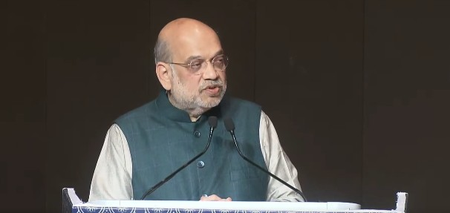
New Delhi, Feb 10 (IANS) Highlighting the need to counter institutionalised cyber crime, Union Home Minister Amit Shah said on Tuesday that security agencies led by the Indian Cyber Crime Coordination Centre (I4C) have saved or frozen over Rs 8,000 crore out of Rs 20,000 crore swindled by scamsters till November 30, 2025.
Addressing the National Conference on Tackling Cyber-Enabled Frauds Law Dismantling the Ecosystem organised by the Central Bureau of Investigation (CBI), HM Shah said 82 lakh cyber crime complaints were reported till November 30, 2025 and out of these 1.84 lakh cases were converted into FIRs.
He said the curb on cyber crimes and fund recovery needs to be taken to the next step.
Urging the 562 delegates attending the conference to help raise the fight against cyber crimes to the next level, HM Shah said, “Cyber criminals have now started operating in an institutionalised manner. They manage to remain two steps ahead of law enforcers in terms of use of technology.”
Describing cybercrime as a major threat to the world, he said the government is committed to securing citizens, and in this direction, a robust anti-cybercrime infrastructure has been created since 2020 with the formalisation of the I4C’s real-time reporting set up.
He said that while 62 banks and financial institutions have already been onboarded in the secure framework, the government aims to involve all cooperative banks as well by December 31.
Earlier, taking to the social media platform X, the Home Minister said, “Cybercrime is a major threat to the world today. Our government is resolved to protect citizens from it. Today, will address the National Conference on ‘Tackling Cyber-Enabled Frauds and Dismantling the Ecosystem’ organised by CBI to bolster India’s cybercrime combat prowess.”
The Home Minister also preside over an investiture ceremony of CBI officers. He inaugurated the new Cybercrime Branch of the CBI and launched the S4C Dashboard of the Indian Cyber Crime Coordination Centre (I4C), Ministry of Home Affairs.
The conference was organised by the CBI in collaboration with the Indian Cyber Crime Coordination Centre (I4C), Union Ministry of Home Affairs.
The CBI has been investigating cybercrime since 2000 and has upgraded its capabilities over the years. It established the Cybercrime Investigation Division in 2022 to strengthen its specialised response.
The agency serves as the nodal body for investigating cybercrime affecting the Central government and its offices, and handles both cyber-dependent crimes and cyber-enabled frauds, said a statement.
The conference was convened at a time when, under the leadership of Prime Minister Narendra Modi, India’s rapid digital transformation had significantly improved access to banking, governance, and communication. However, it has also created new vulnerabilities which are being exploited by organised cybercriminal networks.
According to officials, the primary objectives of the conference included building a shared understanding of the scale, trends, and evolving nature of cyber-enabled fraud in India.
It will also examine the three critical pillars of the cyber-fraud ecosystem — the financial pillar, which includes mule accounts and money laundering; the telecom pillar, which includes misuse of SIM/eSIM and digital infrastructure; and the human pillar, which includes cyber slavery and trafficking into scam compounds.
The conference also aimed to strengthen inter-agency and public-private collaboration among law enforcement agencies, banks, telecom providers, regulators, and technology platforms.
It also explored the use of artificial intelligence and data analytics to scale investigations with limited manpower, and improve mechanisms for faster fraud reporting, real-time fund tracing, timely evidence preservation, and better victim protection.
The conference sought to drive a unified strategy to combat cyber-enabled fraud by strengthening prevention, investigation, technology adoption, inter-agency coordination, and victim-centric frameworks.
–IANS
rch/dan