Radio Brisvaani

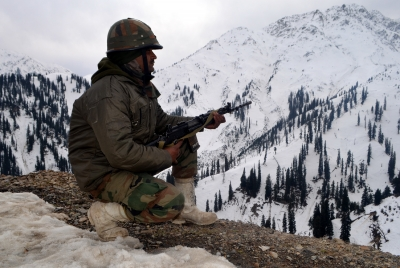
New Delhi, Dec 29 (IANS) For the past week, the Indian Army has carrying out a major operation to pin down at least 30-35 terrorists in Jammu and Kashmir, and it is one of the toughest that the force has launched in recent times owing to multiple factors.
For one, it is the freezing phase of Chilai Kalan during which cold peaks across the Valley. The Chillai Kalan begins on December 21 and ends on January 31.
An official said that from January 31 onwards, one could expect much more progress in the ongoing operation as the weather would be more conducive for the security forces.
While the weather is a major deterrent, security agencies have noticed a major shift that the 30-35 Jaish-e-Mohammad terrorists have made.
The notable shift that the terror group has made this time around is the timing of their operation. During this phase, they normally lie low, but this time around, they are trying to carry out an operation despite the weather not being helpful.
The terrorists who have spread across the Doda and Kishtwar belt are active, and this is a change in pattern that the security agencies have noticed.
Further, they have isolated themselves at higher altitudes, something that they normally do not do.
Previously, during this phase, terrorists normally would take shelter in the homes of locals. They would also be given food and support by the locals, but this time around, they have stayed away.
Officials say that the locals are refusing to help them out following the Pahalgam attack, and this explains why they have decided to isolate themselves.
An Intelligence Bureau official said that there is no doubt that the terrorists have taken a big risk, both in logistics and health-wise. Operating at such high-altitudes during such a time puts them at risk of being eliminated easily by the security forces.
That the terrorists have decided to take that risk makes it important for the agencies to be careful, as these terrorists are likely to attempt a low-scale attack, an official said.
Taking such a huge risk, knowing fully well that they can only mount a low-scale attack, is also a sign of desperation.
Operation Sindoor, carried out by the Indian armed forces to avenge the Pahalgam attack, has crippled the terror infrastructure to a large extent.
With infiltrations dropping to almost nil, Pakistan has decided to activate some of its existing terrorists in the Valley to carry out a strike.
An attack in Jammu and Kashmir, even if it were to be a low-scale one, is important in the context of recruitment.
Any attack, Pakistan believes, would raise the morale of the existing cadres, while newer ones would want to join the terror groups, officials say. Moreover, the terrorists are maintaining very little communication to avoid detection.
Further, these terrorists have decided to carry out the operation in smaller groups so that the entire lot does not get eliminated at once, the agencies have learnt.
The rules of the game have changed for these terrorist groups. Usually, operations would stall entirely during this time owing to harsh weather. However, these groups have decided to indulge in acts of terror no matter what the weather is. They are fully aware that they are incapable of mounting a large-scale attack during such times, but they are ready to take the risk, and this once again is a sign of desperation.
This has also been a challenge for the security forces as they have to remain on guard all through the year.
The army has intensified its operations despite have to deal with the harsh weather and treacherous terrains. It has also changed its strategy and taken a provocative posture during the winter. It has also not reduced activities as it normally does in the past, but instead increased them. It has also set up snowbound bases to counter these terrorists.
Union Home Minister Amit Shah had told the security forces to remain on a state of very high alert in Jammu and Kashmir as terrorists would look to take advantage of the snowfall while trying to cross over into India from Pakistan. The Indian agencies have said that several launch pads have come up in Pakistan-occupied Kashmir (PoK). However, the terrorists are finding it hard to infiltrate due to high security and constant vigil.
–IANS
vicky/vd