Radio Brisvaani

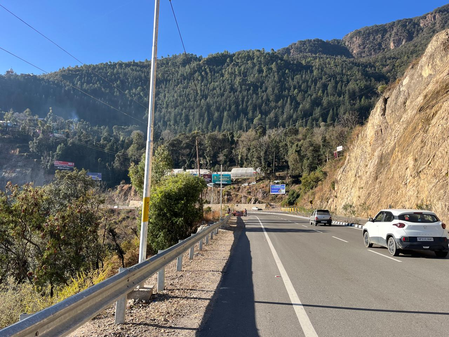
Shimla, Feb 9 (IANS) Four-laning of the British-era Kalka-Shimla highway via Parwanoo in Himachal Pradesh, a ribbon of asphalt twisting through hills and soaring over flyovers, is finally inching towards completion after more than a decade of construction.
Driving on it now is fast, smooth, almost effortless, but it comes at a small price. The national highway 5, part of the ancient and historical route of Hindustan-Tibet Road, has bypassed some of the old colonial-era landmarks: the quaint train crossings, the gentle curve where tracks once ran alongside the road, and the tiny, lingering memories of Shimla’s British past. All that remains is one final piece of the puzzle: a tunnel near Kandaghat in Solan district, the town known for its vibrant vegetable markets.
The air there always carries the scent of fresh produce and earthy soil, and the bustling streets are alive with vendors calling out to passersby. The tunnel promises to carry vehicles past this lively rhythm, saving time while leaving Kandaghat’s pulse intact for those who live and work here.
For years, landslides and other factors held the project back, but the Himachal Pradesh High Court’s scrutiny seems to have put the highway back on the fast track.
Officials say the remaining works, especially the Kandaghat tunnel, the last one, are now moving at pace, bringing motorists closer to a seamless journey between the plains and Shimla’s hills.
Once open, the highway will run like a silver thread through pine forests, over flyovers that appear to float above deep gorges, and through tunnels cutting cleanly through hillsides. Mist will curl around deodars, sunlight will shimmer off stone bridges, and Shimla, perched patiently at the top, will await travellers with its familiar charm.
In the 1970s, the Parwanoo-Shimla was upgraded to a national highway. Motorists to the erstwhile summer capital of British India, taking the highway, bypass the old towns of Parwanoo, Kumarhatti, Barog and Kandaghat. Missing landmarks like railway crossings along the narrow gauge Unesco World Heritage tag Kalka-Shimla rail track, the bazaars of Dharampur and Barog and the statue of Rani Jhansi at Chambaghat also mark their travel.
The work on the project was started on September 21, 2015, and was scheduled to be over by March 21, 2018. As per Union Minister for Road Transport and Highways Nitin Gadkari, a 160-m-long viaduct has been constructed using the method of hydraulic push launching of superstructure in the construction of this project, a remarkable achievement.
Currently, the work on constructing a 667-m twin-tube tunnel and a 368-metre flyover in Kandaghat is in progress. However, the four-laning of the 88-km stretch between Shimla and Parwanoo that aims to cut travel time by 17 km is largely complete.
Another, the 936-m one-way tunnel on the Barog bypass is already motorable. Constructed with an outlay of Rs 100 crore, it reduces the distance on the highway by 3.5 km. Also, two overbridges over the Kalka-Shimla narrow gauge heritage railway line in Sanwara and Chambaghat and a flyover in Kumarhatti, reduce the distance by three km.
“It’s wonderful to see how infrastructure in Himachal Pradesh is improving by the day,” Neha Dubey, a motorist from New Delhi, told IANS, while pointing towards the British-era Solan Brewery while standing on a flyover passing through its complex.
Edward Dyer opened a brewery nearby Kasauli hills in 1855 and a distillery in Solan town, known as India’s Mushroom and Red Gold City, owing to the vast mushroom and tomato farming, respectively.
Going nostalgic, her husband Virain remarked, “If you are driving at speed, there are chances you can give a miss to the Solan distillery too, a prominent British landmark.”
Driving uphill to Shimla, he added, with the construction of the new highway, they missed Chakki Mod, once a popular hangout spot for the youngsters near Kasauli.
Old-timers recall the zig-zag of the old highway, along tunnels of the heritage rail tracks, which were once the famous selfie points with the air filled with the aroma of fluffy omelettes and roasting corn from roadside vendors.
As per history, the work on the Hindustan-Tibet Road from Kalka to Shimla via Parwanoo started by British India in 1850. A ‘mail wagon’ drawn by horses first began running up to Shimla by 1860’s. Later, motor cars started plying on the Kalka-Shimla section by 1935.
As per the National Highways Authority of India, the executing agency, the PRAGATI-enabled top-level review and monitoring by the Project Monitoring Group under the digital governance ecosystem played a decisive role in resolving long-pending inter-departmental and inter-governmental issues affecting the 39-km-long Parwanoo-Solan section, which was executed with an outlay of Rs 1,635 crore.
This section traverses 33 revenue villages, including major habitations in the Solan district and passes through densely populated and environmentally-sensitive hilly terrains.
(Vishal Gulati can be contacted at vishal.g@ians.in)
–IANS
vg/dpb