Radio Brisvaani

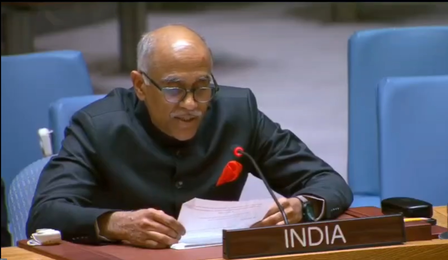
United Nations, Jan 27 (IANS) India has expressed concern over the emergence of platforms “parallel” to the United Nations, seeking to take on peace and security roles while the Security Council is paralysed.
“Security conversations and discussions have moved on to parallel plurilateral frameworks, some even involving private sector actors to bring about outcomes on peace and security outside the United Nations,” India’s Permanent Representative P. Harish cautioned on Monday, pressing the case for Council reform.
Secretary-General Antonio Guterres said no organisation or “ad-hoc” coalition can usurp the powers of the Council.
The Council alone can make decisions binding on all, and “no other body or ad-hoc coalition can legally require all member states to comply with decisions on peace and security”, he said while speaking at the Council at a high-level debate on “Reaffirming International Rule of Law”.
“Only the Security Council can authorise the use of force under international law, as set out in the Charter”, he said. “Its responsibility is singular. Its obligation is universal.”
Therefore, he said, Council “reform is essential”.
“That is why we must act without delay to enhance the representation and effectiveness of this Council,” he added.
Guterres’ reference to an “ad hoc coalition” and Harish’s mention of “parallel plurilateral frameworks” were about the Board of Peace that US President Donald Trump has created and is seen as a challenge to the UN.
With diplomatic finesse, they were careful not to name him or the Board.
Trump said last week at Davos: “Once this (Peace) Board is completely formed, we can do pretty much whatever we want to do.”
Although he added a rider, “We’ll do it in conjunction with the United Nations”, it still meant he was seeing a downgraded role for the UN, losing its monopoly under the Charter for using force to enforce international peace and security.
Trump announced the Board as a part of his Gaza peace plan under which it was to oversee the rebuilding of the devastated territory.
The plan received the approval of the Security Council.
Trump has since said the Board could take on a broader role in international security.
The Board of Peace has 22 members, including Pakistan, and Trump has offered “permanent” membership for contributions of $1 billion.
Except for Belgium, Western countries have so far stayed away from the Board, where the majority — 13 members — is made up of Muslim majority nations.
Calling for urgent reform of the Council and adding permanent members, Harish said that it was essential to make the international rule of law effective when the world organisation “at its core is under strain”.
“Paralysis and lack of effectiveness in tackling conflicts remain a significant shortcoming”, testing the UN’s credibility.
Because of the veto powers of the permanent members, the Council was not able to act on crises like Gaza and Ukraine.
“For multilateralism and international rule of law to remain effective and credible, global governance structures must evolve to reflect contemporary realities,” he said.
While the world has undergone a profound transformation in the 80 years since the UN’s founding, the Council is stuck in a bygone era, he said.
Given the changes in “power dynamics, demographics and the nature of global challenges, there’s an urgent and compelling need to undertake comprehensive reform, including expansion in the permanent and non-permanent categories”, the Indian diplomat said.
–IANS
al/vd
United Nations, Jan 27 (IANS) India has expressed concern over the emergence of platforms “parallel” to the United Nations, seeking to take on peace and security roles while the Security Council is paralysed.
“Security conversations and discussions have moved on to parallel plurilateral frameworks, some even involving private sector actors to bring about outcomes on peace and security outside the United Nations,” India’s Permanent Representative P. Harish cautioned on Monday, pressing the case for Council reform.
Secretary-General Antonio Guterres said no organisation or “ad-hoc” coalition can usurp the powers of the Council.
The Council alone can make decisions binding on all, and “no other body or ad-hoc coalition can legally require all member states to comply with decisions on peace and security”, he said while speaking at the Council at a high-level debate on “Reaffirming International Rule of Law”.
“Only the Security Council can authorise the use of force under international law, as set out in the Charter”, he said. “Its responsibility is singular. Its obligation is universal.”
Therefore, he said, Council “reform is essential”.
“That is why we must act without delay to enhance the representation and effectiveness of this Council,” he added.
Guterres’ reference to an “ad hoc coalition” and Harish’s mention of “parallel plurilateral frameworks” were about the Board of Peace that US President Donald Trump has created and is seen as a challenge to the UN.
With diplomatic finesse, they were careful not to name him or the Board.
Trump said last week at Davos: “Once this (Peace) Board is completely formed, we can do pretty much whatever we want to do.”
Although he added a rider, “We’ll do it in conjunction with the United Nations”, it still meant he was seeing a downgraded role for the UN, losing its monopoly under the Charter for using force to enforce international peace and security.
Trump announced the Board as a part of his Gaza peace plan under which it was to oversee the rebuilding of the devastated territory.
The plan received the approval of the Security Council.
Trump has since said the Board could take on a broader role in international security.
The Board of Peace has 22 members, including Pakistan, and Trump has offered “permanent” membership for contributions of $1 billion.
Except for Belgium, Western countries have so far stayed away from the Board, where the majority — 13 members — is made up of Muslim majority nations.
Calling for urgent reform of the Council and adding permanent members, Harish said that it was essential to make the international rule of law effective when the world organisation “at its core is under strain”.
“Paralysis and lack of effectiveness in tackling conflicts remain a significant shortcoming”, testing the UN’s credibility.
Because of the veto powers of the permanent members, the Council was not able to act on crises like Gaza and Ukraine.
“For multilateralism and international rule of law to remain effective and credible, global governance structures must evolve to reflect contemporary realities,” he said.
While the world has undergone a profound transformation in the 80 years since the UN’s founding, the Council is stuck in a bygone era, he said.
Given the changes in “power dynamics, demographics and the nature of global challenges, there’s an urgent and compelling need to undertake comprehensive reform, including expansion in the permanent and non-permanent categories”, the Indian diplomat said.
–IANS
al/vd