Radio Brisvaani

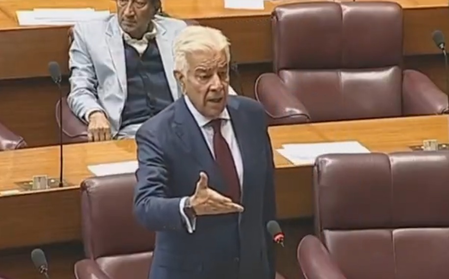
Kabul, Feb 14 (IANS) Pakistan Defence Minister Khawaja Asif’s recent admission in the country’s parliament – that the country had “rented itself out” to the United States after 9/11 – proved the long-held views of Afghans right that Islamabad simultaneously nurtured militant proxies, shaped regional narratives, and externalised the costs onto Afghan society, a report said on Saturday.
According to a report in the ‘Afghan Diaspora Network’, Asif’s remarks have drawn sharp reactions from prominent Afghan political figures, whose varied responses converge on a common criticism that Pakistan’s political and military establishment has long played a double game in Afghanistan, with the Pakistani Defence Minister’s selective confession providing partial insight and also concealing key details.
Former Afghan intelligence chief Rahmatullah Nabil offered the most forceful rebuttal, arguing that Asif’s comments are “not an honest reckoning but a revisionist attempt to sanitise decades of Pakistani policy”.
“Nabil highlights the contradictions in Asif’s narrative: the same politician who now frames Pakistan’s involvement in Afghanistan as a purely political miscalculation once invoked religious legitimacy when the Taliban returned to power, telling the United States, ‘Power is yours, God is with us’,” the report mentioned.
“For Nabil, this contradiction exposes the deeper problem: Pakistan’s Afghan policy has always blended ideology, geopolitics, and opportunism. To retroactively reduce it to “political mistakes” is, in Nabil’s words, an evasion of responsibility for the human cost borne by Afghans – graveyards, displacement, and destroyed villages,” it added.
The report stressed that former US Ambassador to Afghanistan, Zalmay Khalilzad views Asif’s remarks from another perspective, underscoring Pakistan’s strategic duplicity throughout the US-led war on terror.
“Khalilzad notes that while Pakistan received billions in military and financial support for assisting US operations, its security establishment simultaneously provided sanctuary to the Taliban insurgency fighting American forces,” it noted.
Former Afghan Member of Parliament Mariam Solaimankhil adds another dimension by emphasising the human cost of Pakistan’s policies, stating that Asif’s remarks are “not merely contradictory – they are dismissive of Afghan suffering”.
“Soliamankhil argues that Pakistan’s decades-long involvement in Afghanistan was not an accidental byproduct of global politics but a deliberate strategy rooted in ideological engineering, from madrassa curricula to jihadist narratives. Solaimankhil’s critique aligns with Nabil’s: Pakistan was not simply a victim of geopolitical pressures but an active architect of the very forces that destabilised Afghanistan,” the report stated.
–IANS
scor/as