Radio Brisvaani

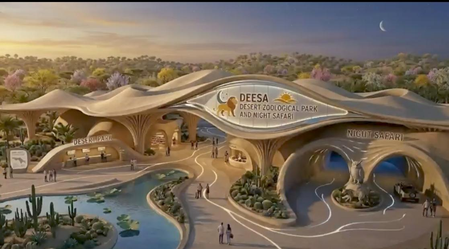
Banaskantha, Aug 12 (IANS) Gujarat’s proposed 103-hectare desert-themed zoological park and drive-through night safari at Juna Deesa in Banaskantha district has received approval from the Central Zoo Authority (CZA), clearing the way for a project estimated to cost Rs 542.14 crore.
The facility, planned by the state Forest Department, is intended to combine wildlife conservation, rescue and rehabilitation with environmental education and tourism.
The project is expected to house around 2,700 native and exotic animals and birds representing nearly 83 species.
Forest and Environment Minister Arjun Modhwadia said the project would be developed on government land in accordance with CZA guidelines.
“The proposed Desert Zoological Park and Night Safari is being developed over about 103 hectares of government land at Juna Deesa. The project has been prepared in accordance with Central Zoo Authority guidelines and has an estimated cost of Rs 542.14 crore. It has now received approval from the Central Zoo Authority,” he said.
Minister of State for Forests and Environment, Pravin Mali, said the facility had been planned as a modern conservation centre.
It will include a separate day zoo and five dedicated night safari enclosures, allowing visitors to observe nocturnal animals after sunset.
“The project will not only provide visitors with a unique wildlife experience but will also serve as a centre for conservation breeding, wildlife rescue, rehabilitation, environmental education and scientific interpretation of nature,” said Mali, who represents the Deesa Assembly constituency.
“One of the main attractions of the project will be its international-standard Night Safari, where visitors will be able to observe nocturnal animals in specially designed enclosures after sunset. The project will also include a separate day zoo and five dedicated Night Safari enclosures,” he added.
Principal Chief Conservator of Forests (Wildlife) and Chief Wildlife Warden Gujarat, Dr Jaipal Singh, said the park would be designed around a desert ecosystem with natural arid landscapes.
Species planned for the facility include chinkara, blackbuck, Indian wild ass, Asiatic lion and leopard. “The zoo will also have separate enclosures for herbivores and carnivores, an aviary, a reptile house, a butterfly park, an interpretation centre, a food court, a souvenir shop, golf cart services and other visitor facilities,” Singh said.
The Indian desert species planned for display include the Indian porcupine, Indian hare, hedgehog, desert hare, Indian wild ass, sloth bear, caracal, Indian wolf, golden jackal, striped hyena and Indian desert fox.
A reptile safari, rainforest biome and aquarium will also be part of the attractions. The project will also feature animals from African and Australian desert ecosystems.
The proposed African species include Angolan giraffe, Grevy’s zebra, scimitar oryx, African kudu, springbok, addra gazelle, black rhinoceros, chimpanzee, meerkat, African cheetah, African lion, fennec fox, bat-eared fox and ostrich. Kangaroos, emus and wallabies are among the Australian species proposed.
Chief Conservator of Forests (Gandhinagar Wildlife Circle) Aradhana Sahu said environmental safeguards had been incorporated into the project.
“The project will incorporate green technologies such as rainwater harvesting, a sewage treatment plant, solid waste management systems, solar energy, native plantations and green buffer zones to minimise its environmental impact,” she said.
Forest officials said Juna Deesa was selected because of its contiguous 103 hectares of land, natural sand dunes, proximity to the Banas River and road and railway connectivity.
Deputy Conservator of Forests (Banaskantha Wildlife Division) Popattrao Garrdi said the project was expected to add to the region’s tourism infrastructure alongside destinations such as Vadnagar, Ambaji and Nadabet.
“Once completed, it will emerge as a flagship wildlife conservation and eco-tourism destination,” he said.
The project is part of Gujarat’s wider efforts to expand wildlife conservation and eco-tourism infrastructure.
The proposed Deesa facility will place particular emphasis on desert habitats while providing dedicated spaces for conservation breeding, rescue, rehabilitation and public education.
CZA guidelines regulate the establishment and operation of zoos and night safari facilities in India.
–IANS
mys/dpb