Radio Brisvaani

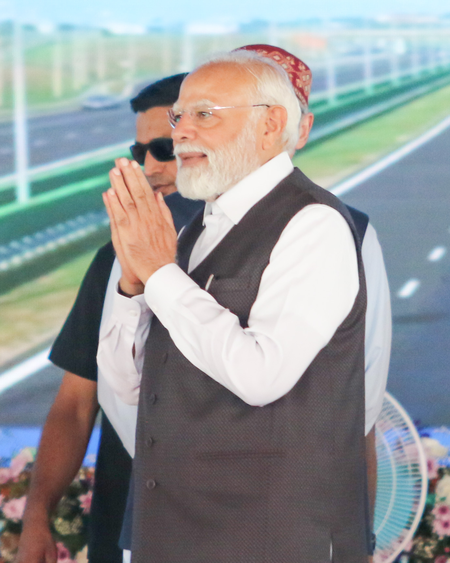
Jammu/Srinagar, June 10 (IANS) As Prime Minister Narendra Damodardas Modi has become the longest-serving Prime Minister in the history of the world’s largest democracy, one of the most significant aspects of his legacy remains the transformation of Jammu and Kashmir.
The most outstanding contribution of Prime Minister Narendra Modi’s tenure has been the physical and psychological integration of the country. Above all, bringing terrorism to its lowest ebb in Jammu and Kashmir is perhaps one of the most significant, yet understated, achievements of his 12-year-old government.
From the times when political leaders told separatists in Kashmir that “the sky was the limit” for the contours of dialogue, Modi proved that not only was the sky unavailable, but there was no longer any space on the ground for separatism and terrorism in the region.
The abrogation of Article 370 — a topic previously considered untouchable — was executed with firm resolve in 2019. Abrogation of Article 370 was a topic nobody even dared talk about. While mainstream Kashmiri politicians once claimed that abrogating Article 370 would “burn the bridge” connecting J&K to India, Modi proved that the entire country was one mainland, and that such bridges were unnecessary for national unity.
Today, terrorism has been depleted of the “oxygen” it once sustained. Kashmiris can now breathe in air free of fear, filled instead with new opportunities. Whether a specific political party benefits in J&K elections is an immature argument; the true victory is that India has overcome separatism, fundamentalism, fear, and isolation in the region.
PM Modi has ensured that the “Idea of India” has been restored in J&K, and for the people of the Union Territory, that may well rank among the most significant achievements any government at the Centre has accomplished.
PM Modi’s most enduring contribution has been his ability to connect directly with vast sections of the Indian population and inspire confidence in India’s future. His leadership has coincided with a period in which India has increasingly viewed itself not merely as a developing nation, but as a rising global power with growing economic, technological and strategic influence.
Born in Gujarat on September 17, 1950, in a poor family struggling for survival, PM Modi was no extraordinary child except for his bravery and obedience to his parents. Who could have imagined that one day this village lad would make every citizen of the country proud to have elected him as the Prime Minister?
Neither the beginning nor the continuation of his ongoing longest-serving Prime Ministerial term has anything even remotely ordinary about it.
The PM speaks a language most of his detractors call daydreaming, but the speed with which he converted his so-called ‘daydreams’ into reality has left detractors dumbfounded. He did to India what nobody thought could ever be done.
He changed the metaphor of a poor struggling nation into the narrative of one of the fastest-growing economies in the World.
The lad born in a sleepy Gujarat village has awakened India to a new dawn— the dawn of self-reliance, honour, dignity, sovereignty, integrity and pride. He has realised the dream of prosperity for the common Indian faster than anybody could have ever imagined.
The PM started national flagship programmes, for which, a few months before he came to power, nobody thought India had the financial resources to sustain.
He did not transform the vocabulary of Indian politics; he re-wrote it. Few leaders since Independence have been able to establish such a direct connect with the electorate.
Be it sanitation, clean cooking fuel for women, rural electrification, housing programmes for the poor, solar energy initiatives and food-security measures benefitting hundreds of millions of citizens, all he did has significantly impacted the lives of ordinary Indians.
The expansion of educational and healthcare institutions has also been noteworthy. In domestic politics, Modi continues to demonstrate a determination to pursue his proclaimed goals.
In foreign affairs, he has also taken important initiatives. His extensive international engagements have strengthened India’s relations with major powers as well as countries across the developing world. India’s growing diplomatic profile, leadership role in the Global South, and enhanced visibility in international affairs gel perfectly with the resolution of a longstanding civilisation and culture.
As he reaches another historic milestone in public office, the integration of Jammu and Kashmir, alongside his broader governance and development agenda, will remain among the defining features of Modi’s political legacy.
–IANS
sq/snj/skp