Radio Brisvaani

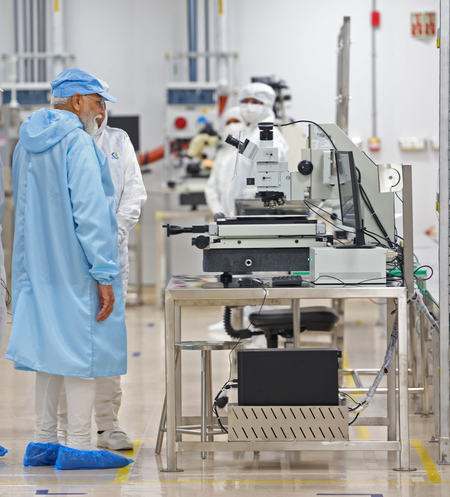
New Delhi, July 10 (IANS) The Central government’s decision to rationalise customs duties on capital equipment and critical inputs for electronic good production will deepen domestic value addition and attract investment, industry bodies said on Friday.
The government has rationalised duties for inputs in lithium‑ion battery cell manufacturing, display assemblies and wireless charging inductor coil modules.
Ashok Chandak, President of the India Electronics and Semiconductor Association (IESA) found the relief as “much more than a customs duty rationalisation” as it would lower capital costs, improve project viability and catalyse investments across the electronics value chain.
The move will accelerate India’s transition from an assembly-led economy to a globally competitive electronics manufacturing hub, Chandak added.
The policy complements existing schemes such as the Electronics Component Manufacturing Scheme (ECMS) and the Semicon India Programme.
“”This is much more than a customs duty rationalisation—it is a strategic investment in India’s manufacturing future. The government is enabling higher domestic value addition, improving global competitiveness and making India a more attractive destination for electronics manufacturing investments,” Chandak said.
Smartphones, EVs, telecom systems, medical devices and energy storage solutions built in India creates demand for semiconductors. A stronger component ecosystem today lays the foundation for a stronger semiconductor ecosystem tomorrow, he added.
Pankaj Mohindroo, Chairman of the Indian Cellular and Electronics Association (ICEA), welcomed the broadening of duty dispensation for display assemblies to include automotive, medical and industrial displays, saying it would help build industry verticals in these segments similar to the growth seen in mobile and consumer electronics display assembly.
India’s electronics market is projected to exceed $400 billion by 2030, while semiconductor demand is expected to cross $103 billion during the same period.
Simultaneously, India is building a multi-hundred GWh lithium-ion battery manufacturing ecosystem to support the rapid growth of electric mobility and energy storage.
Lower duties on manufacturing equipment will improve the competitiveness of these investments and strengthen supply chain resilience.
–IANS
aar/na