Radio Brisvaani

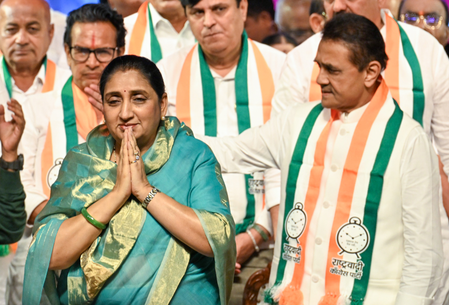
Mumbai, July 13 (IANS) The structural cracks within the Nationalist Congress Party (NCP) have widened into a high-stakes battle for organisational control following the untimely demise of former national president and Maharashtra Deputy Chief Minister Ajit Pawar. Admitting to the massive political vacuum, NCP National Working President and Rajya Sabha MP Praful Patel said on Monday that while it is difficult to fill the void left by Ajit Pawar, the party must take “corrective steps” to remain relevant in both state and national politics.
Patel’s admission comes amid intense speculation in political circles over growing internal discontent, intra-party wrangling and the absence of a decisive leader.
With Sunetra Pawar taking the reins as National President and Parth Pawar assuming a larger organisational role, operational friction has reportedly emerged between senior party veterans and the immediate family.
Political observers note that leadership vacuums are invariably filled, either through internal succession or by external rivals. For the NCP, survival depends on institutionalising the organisational machinery built by Ajit Pawar rather than attempting to replicate his individual leadership.
Without Ajit Pawar’s centralised authority, simmering internal tensions have reportedly surfaced, threatening a split across three major organisational fault lines.
The most visible indication of the internal discord emerged from a recent formal communication to the Election Commission of India (ECI). When the party submitted its revised list of national office-bearers and executive committee members, the names of veteran leaders Praful Patel and State President Sunil Tatkare were reportedly either omitted or shown without their official designations. Although the leadership dismissed the omission as a “typographical error”, it triggered speculation within political circles.
Senior leaders reportedly suspect a deliberate attempt to sideline the old guard and centralise operational control under the family leadership. Seasoned strategists who aligned with the faction because of Ajit Pawar are said to be wary of a legacy-driven hierarchy. There is also apprehension that ticket distribution and resource allocation for upcoming elections could be influenced more by family loyalists than by collective party consensus.
Furthermore, sections of the cadre have alleged that external allies within the ruling Mahayuti coalition may be quietly exploiting these divisions to weaken the NCP’s bargaining position. As a constituent of the ruling Mahayuti alliance, the NCP faces the challenge of protecting its political space.
Without Ajit Pawar’s aggressive bargaining style, there are concerns that the party could be overshadowed by the BJP. “The remaining leadership must prove they can still deliver a crucial chunk of the Western Maharashtra and Marathwada vote bank to maintain equal footing,” a senior minister said on condition of anonymity.
Party insiders emphasise that attempting to replace Ajit Pawar with a single individual could trigger further internal rivalries. Instead, there is growing support among observers for a high-powered collective leadership council. They have suggested consensus-based decision-making by combining the administrative experience of senior leaders such as Praful Patel and Sunil Tatkare with influential regional faces, while assigning Sunetra Pawar and Parth Pawar clearly defined organisational responsibilities.
According to a party minister, the immediate priority for the new leadership is to assure the grassroots cadre that “Ajit Dada’s” developmental blueprint for the region will not be abandoned. The minister added that the NCP stands at a critical crossroads, and that the coming weeks will determine whether the party can successfully transition into a collective institution or whether the widening internal cracks will lead to fragmentation.
–IANS
sj/pgh