Radio Brisvaani

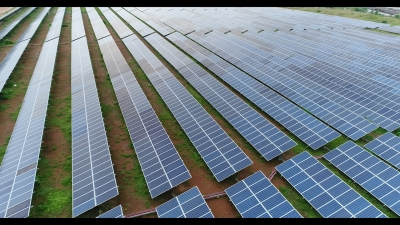
New Delhi, June 29 (IANS) Emerging demand scenarios could lift India’s annual solar installations from around 50 GW in FY27 to nearly 85 GW by FY30, a report said on Thursday.
The report from Equirus Securities said data centres, green hydrogen and night-time connectivity could add 15-20 GW of incremental solar demand annually from FY29.
India’s utility solar sector has a robust multi-year growth runway, with 145 GW of signed power purchase agreements (PPAs) and 68 GW of pending awards supporting sustained demand for project execution.
The report said the country has built a 2.5-year utility solar pipeline, with 215 GW of Letters of Award (LOA) won during FY18-FY26.
Among them, 145 GW PPAs have already been signed and 75 GW executed. It leaves a balance pipeline of 70 GW, including 58 GW of solar and 12 GW of wind, with annual utility installations running at around 21 GW.
Around 58 GW of unsigned solar PPAs remain outstanding, of which 73 per cent are plain solar or hybrid projects. Around 43 GW falls under plain solar and hybrid tenders, where signing probability remains low.
As much as 15 GW comprises RTC (Round-The-Clock), FDRE (Firm and Dispatchable Renewable Energy), and Solar+BESS (Battery Energy Storage Systems) projects, where signing probability is high, the report noted.
The firm said the current re-tendering cycle represents a structural tailwind for domestic integrated IPPs, as DISCOMs pivot towards firm power, preferring supply during both solar and non-solar hours.
The report noted that new tenders are shifting decisively toward firm power formats, with focus on Battery Energy Storage Systems (BESS) and FDRE/RTC structures, adding that integrated IPPs with storage and firm supply capability are the structural winners.
India has approved over 300 data centre projects, with AWS, Microsoft and Google committing Rs 2-3 lakh crore each, while AI inference requires round-the-clock power, making Solar+BESS the most cost-effective solution at scale.
Each 100 MW data centre would require around 250 MW of solar, 150 MW of wind and nearly 450 MWh of battery energy storage to operate entirely on renewable power.
The report highlighted India’s 5 million tonne annual green hydrogen production target by 2030 under the National Green Hydrogen Mission, estimating that each one million tonne of hydrogen production would require about 20 GW of dedicated solar capacity.
India’s BESS-based storage demand is projected to rise from 34.7 GWh during 2022-2027 to 236.2 GWh during 2027-2032. The growth is being driven by renewable integration and grid stability needs, policy support through storage mandates, and improving project economics, the report added.
—IANS
aar/pk