Radio Brisvaani

New Delhi, April 5 (IANS) As the US-Iran conflict drags into its second month — unsettling markets, testing alliances — one thing is becoming clear: the world does not need longer wars. It needs smarter outcomes.
That is why it is worth revisiting a decision closer home — one that, at the time, drew sharp criticism from the Congress-led opposition. When the Modi government chose to halt Operation Sindoor soon after achieving its objective, the opposition was quick to call it hasty, even short-sighted.
In hindsight, that criticism now feels more reactive and political than reasoned. Because strategy — especially in matters of national security — is rarely about how things look in the moment. It is about clarity of purpose, and just as importantly, about knowing when that purpose has been served. Not every show of strength needs to be stretched out to prove a point.
India could have extended Operation Sindoor (May 7, 2025 – May 10, 2025). It had the operational capacity to escalate, broaden the scope, or extend the engagement. It chose not to. The objective was clear, and once met, the operation was halted. Within days, Pakistan had been pushed onto the back foot, seeking relief and a ceasefire agreement. That was the outcome India was aiming for.
And perhaps that is what made it uncomfortable for some — there was no prolonged build-up, no dramatic escalation, no extended theatre. Just a swift, contained result.
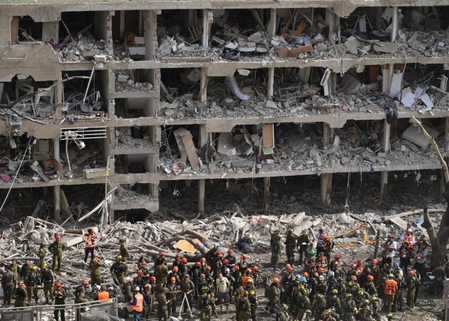
Now, shift the lens to West Asia. Despite repeated assertions of control, the US appears increasingly caught in a conflict that is deepening — widening rather than settling.
US President Donald Trump continues to project confidence, but the ground reality tells a more complicated story. Iran, for its part, has shown that it retains the capacity to respond. The back-and-forth continues, and with it, the uncertainty.
The unease around the Strait of Hormuz says enough. The disruption is sending ripples across global energy markets. That is the problem with prolonged conflicts: they rarely stay contained, and their consequences travel far beyond the immediate theatre.
What is also becoming evident is the hesitation among America’s traditional allies. There is support, yes — but not quite the kind that translates into deep involvement. There is caution, a degree of distance, and in some cases, visible discomfort.
French President Emmanuel Macron, in his recent remarks, articulated this shift rather clearly. His call for a “coalition of independence” reflects a growing sentiment — that countries are no longer entirely comfortable being tied too closely to dominant power blocs. Strategic space matters, perhaps more now than before.
For India, this is not unfamiliar ground. Strategic autonomy has long been part of its approach, though the way it is exercised has evolved. From non-alignment to a more flexible, interest-driven engagement, India has gradually built a framework where it can work with multiple partners without being locked into any single axis.
In the middle of the current crisis, New Delhi has largely stayed that course. It has resisted the pressure to take overt sides, while ensuring that its own interests — particularly in energy flows — are not compromised. It is this approach that has allowed India to maintain steady movement through critical routes. Several Indian vessels have continued to pass through the Hormuz Strait despite the prevailing uncertainty.
Diplomatic engagement continues, and where required, support has been extended — quietly, without much noise. And that quietness is easy to miss, especially in a world that often equates visibility with effectiveness.
The longer the conflict continues, the sharper the contrast becomes. Prolonged offensives tend to create more variables than they resolve. They stretch resources, test alliances, and introduce risks that are difficult to anticipate, let alone manage. Swift, clearly defined actions, on the other hand, tend to leave less room for escalation.
Operation Sindoor may not have been widely acknowledged globally, but it demonstrated a principle that is hard to ignore — effectiveness is not measured by duration, but by whether the objective was achieved. Staying longer in a conflict does not necessarily translate into a better outcome; it often does the opposite.
The US and the rest of the world are experiencing this. India understood this a long time ago.
If the past few weeks have shown anything, it is this — drawn-out wars rarely produce clean endings. They create layers of uncertainty — economic, political, and strategic — that take far longer to unwind than the conflict itself.
Decisiveness, restraint, and clarity are often underestimated in moments of high tension. They do not make for dramatic headlines. Ultimately, wars are not won by how long they last, but by how decisively they are concluded.
And that is where India’s approach begins to stand out. Operation Sindoor is perhaps its clearest recent example.
(Deepika Bhan can be contacted at deepika.b@ians.in)
–IANS
dpb/sd/