Radio Brisvaani

New York, Aug 30 (IANS) Religious leaders from 30 countries have pledged to confront hatred, defend persecuted communities and ensure that artificial intelligence remains in the service of humanity.
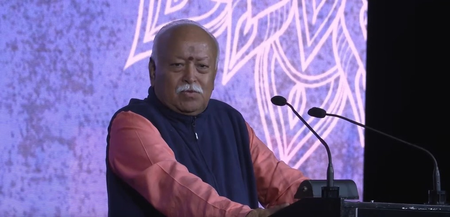
The commitments were unveiled during a ‘Universal Oneness’ gathering at the Madison Square Garden in New York, attended by Rashtriya Swayamsevak Sangh (RSS) Chief Mohan Bhagwat and representatives of several major faiths.
More than 200 religious representatives helped prepare the call to action after negotiations at a conference held earlier on Saturday.
“We will reject the use of religion to justify hatred, humiliation, dehumanisation or violence and teach that deep conviction can coexist with respect for those who believe differently,” the declaration said.
It acknowledged both the power of faith to promote reconciliation and the history of religion being used to deepen divisions.
“We know the extraordinary power of faith to heal, reconcile, and inspire. And the painful truth that religion has sometimes been used to divide, exclude, and justify violence,” it said.
The declaration came against the backdrop of armed conflicts, displacement and growing mistrust across societies. It warned that hatred now travels rapidly across borders through digital platforms.
“No government, institution, or technology can carry responsibility for the moment alone. Neither can religious leaders, but there is a responsibility that is uniquely ours,” it said.
The leaders affirmed the dignity of every person and rejected the idea that unity requires people to abandon their individual beliefs or identities.
“Unity does not require conformity. Conviction does not require contempt,” the declaration said.
Under five commitments, religious leaders pledged to examine the teachings and practices of their own communities, speak out when people are targeted and build relationships across religious and cultural boundaries.
“Peace begins with the courage to hold our own communities accountable,” it said.
The leaders also promised to bring young people from different religious and cultural backgrounds together before disputes or tragedies arise.
“The person we know is harder to hate,” the declaration said.
It called for joint service to people facing hunger, illness, displacement and persecution.
Cooperation, it said, must be evident through action and not merely public declarations.
“Our cooperation should be visible not only in what we say together, but in what we do together,” it added.
The declaration also addressed decisions involving war, poverty, environmental protection and emerging technologies, including artificial intelligence.
“We will insist that human progress remain in the service of human beings and that technology strengthen rather than diminish dignity, truth, freedom and human connection,” it said.
Each participating leader was asked to undertake at least one concrete initiative. These could include bringing together communities that seldom interact, confronting hatred, creating opportunities for young people or serving alongside another religious group.
“We are not naive religious leaders alone cannot enforce limited hatred or reverse every injustice, but neither are we powerless,” the declaration said.
During the gathering, participants tied rakhis on one another as symbols of connection, care and mutual responsibility.
Organisers said the tradition was being extended beyond families to friends, neighbours and communities.
Mohan Bhagwat has served as the Sarsanghchalak, or chief, of the Rashtriya Swayamsevak Sangh since 2009. The RSS, founded in 1925, is marking its centenary and has organisations and affiliates operating in several countries.
–IANS
int/lkj/khz