Radio Brisvaani

Bengaluru, July 19 (IANS) The Indian Institute of Science (IISc) in Bengaluru has successfully developed a method to produce green hydrogen from agricultural waste. Union Minister for New and Renewable Energy, Pralhad Joshi, stated that the Central Government will support this innovation.
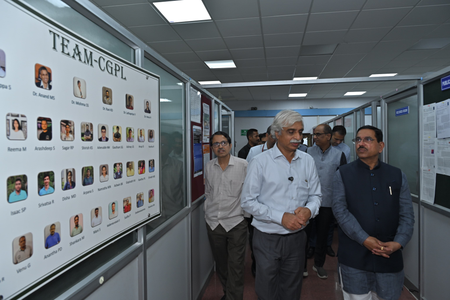
On Friday, the minister visited IISc to witness the new breakthrough that enables green hydrogen production from bio-waste. He praised the institute’s pioneering research.
Using agricultural waste that is typically burnt in fields, IISc has developed an eco-friendly method to produce clean, green hydrogen. The current system has the capacity to generate 5 kilograms of hydrogen per hour with 99 per cent purity, Joshi said.
Agricultural waste is usually burned or left to decompose, releasing methane into the atmosphere. However, IISc has demonstrated to the world that it is possible to produce eco-friendly energy from this waste—an innovation the minister described as a “truly Atmanirbhar” (self-reliant) achievement.
This green hydrogen production from agricultural waste is a unique carbon-reducing research initiative. Each kilogram of hydrogen produced removes over one kilogram of carbon dioxide from the atmosphere, Joshi added.
The minister said that IISc is playing a key role in shaping India’s clean energy future. Through such cutting-edge research, the institute has earned global recognition and national pride. He also extended his gratitude to IISc Director Prof. Govindan Rangarajan, faculty members, and researchers.
Union Minister Joshi received a detailed briefing on the advanced bio-waste-to-hydrogen system developed by Prof. Dasappa and his team. He described the innovation not just as a national achievement but a “global milestone.”
Due to Prime Minister Narendra Modi’s foresight, the National Green Hydrogen Mission has been launched with an investment of Rs 19,744 crore, which is now bearing fruit. However, Joshi emphasised that the success of any national mission is not based solely on funding but also on willpower.
India now has the capacity to produce 5 lakh metric tonnes of green hydrogen annually and has an additional renewable energy capacity of 125 GW. The total investment is Rs 8 lakh crore, creating over 6 lakh jobs. The country also aims to reduce 50 lakh metric tonnes of CO2 emissions annually.
Joshi stated that incentives have already been granted for an annual electrolyser production capacity of 3,000 MW and a green hydrogen production capacity of 8.6 lakh tonnes. He assured support for pilot deployments, capacity expansion, and industrial collaborations.
He outlined four key national challenges before the academic and scientific community: safe hydrogen storage, cost reduction of electrolyser systems, affordability of hydrogen-powered devices, and bringing down the price of green hydrogen. He urged IISc to lead India in green hydrogen research and help position the country as a global leader in sustainable hydrogen technology.
Hydrogen storage remains a challenge. Hence, serious and focused research programs are required to develop safe and affordable hydrogen storage solutions. Researchers must also work towards reducing the cost of electrolyser systems, the minister said.
To make hydrogen-powered vehicles more affordable, it is crucial to develop accessible hydrogen fuel refilling stations. IISc has a vital role in developing high-efficiency, low-cost fuel cell technologies. Under the NGHM, five pilot projects for 37 hydrogen-powered vehicles and nine hydrogen refuelling stations have already been approved.
Currently, green hydrogen costs around Rs 300-400 per kilogram. Bringing it down to Rs 100 per kilogram is an urgent necessity. Referring to NITI Aayog’s Amitabh Kant’s 2030 target of reducing the cost to $1 per kg, Minister Pralhad Joshi said this goal must be taken seriously and pursued effectively.
–IANS
mka/uk