Radio Brisvaani

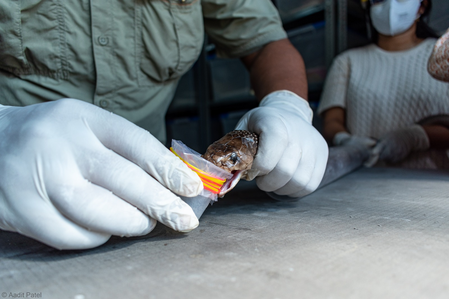
Gandhinagar, July 5 (IANS) Gujarat has moved closer to developing its first region-specific anti-snake venom after the state’s Snake Research Institute (SRI) at Dharampur in Valsad district handed over freeze-dried venom from four venomous snake species found in the state to a licensed manufacturer, a step aimed at improving treatment outcomes for snakebite victims.
The venom was supplied last week by the Snake Research Institute, which functions under the Gujarat Forestry Research Foundation (GFRF), to Telangana-based M/s Vins Bioproducts Limited, a licensed manufacturer of anti-snake venom and other antisera.
The company will now begin producing anti-snake venom customised to venom from snakes found in Gujarat, with the first batch expected to be available for the state in the near future.
State Forest and Environment Minister Arjun Modhwadia said the initiative was intended to address regional variations in snake venom and reduce snakebite-related deaths.
“To reduce human deaths caused by snakebite in the state, Gujarat is developing its own region-specific anti-snake venom. The Snake Research Institute at Dharampur strictly follows the World Health Organisation (WHO) guidelines for maintaining snakes and extracting venom, ensuring the availability of high-quality venom for the production of anti-snake venom,” he added.
The consignment supplied by the Gujarat Forest Department comprised 33.37 grams of Indian cobra venom, 2.67 grams of common krait venom, 30.82 grams of Russell’s viper venom and 1.71 grams of saw-scaled viper venom.
The venom had been lyophilised, or freeze-dried, before being handed over to the manufacturer.
Officials said the availability of a Gujarat-specific anti-venom could contribute to India’s national target of reducing snakebite-related deaths by 50 per cent by 2030.
The manufacturer, M/s Vins Bioproducts Limited, also produces antisera used in the treatment of snakebites and scorpion stings, as well as vaccines against tetanus, diphtheria and gangrene.
The development follows the institute’s first electronic auction of snake venom held earlier this year, during which the venom fetched a higher-than-expected price.
Officials said the outcome reflected adherence to internationally accepted scientific standards in venom collection and processing.
Forest Department officials said region-specific anti-snake venom was an important public health requirement because snakebite accounts for the largest number of human deaths arising from human-wildlife conflict in India.
“Timely administration of effective anti-venom could prevent a substantial proportion of these fatalities,” they added.
S.K. Srivastava, Director of the Gujarat Forestry Research Foundation, said the scale of snakebite mortality highlighted the need for locally developed anti-venom.
“In 2022, wildlife attacks claimed 550 lives across the country, whereas an estimated 65,000 people died due to snakebite during the same period. This huge difference highlights the urgent need for region-specific anti-snake venom. Since this anti-venom is prepared using venom collected from snakes found in a specific geographical region, it is expected to be more effective, require lower doses during treatment, reduce the risk of serious complications such as organ failure following snakebite, and help patients recover faster,” he added.
Experts involved with the project said snake venom differs across geographical regions even within the same species, meaning anti-venom produced using venom from snakes elsewhere in the country may not always provide optimal treatment for bites from snakes native to Gujarat.
To address this, the Gujarat government established the Snake Research Institute at Dharampur, where venomous snakes collected from across the state are maintained and venom is extracted under WHO guidelines before being scientifically processed into a freeze-dried form and supplied to licensed manufacturers through auction.
D.C. Patel, Vice-Chairman of the Snake Research Institute and a surgeon known for treating snakebite victims, said: “One of the major challenges in treating snakebite is that snake venom differs from one region to another. Anti-snake venom prepared using venom from distant regions often proves less effective in treating snakebite. The institute focuses on collecting venom from venomous snake species found across Gujarat to facilitate the development of region-specific anti-snake venom.”
The institute currently houses around 471 venomous snakes representing the principal venomous species found in Gujarat.
According to Srivastava, it has developed scientific infrastructure, a serpentarium and venom-processing facilities, making it one of India’s leading centres for snakebite management, venom research and public awareness.
“After the Irula Snake Catchers Industrial Co-operative Society in Tamil Nadu, it is the second institution in the country supplying venom for anti-venom production,” he said.
Srivastava added that the Gujarat government had allotted 2.25 hectares of land in Valsad district for a permanent campus for the institute, while a proposal worth Rs 11.68 crore had been submitted to develop advanced research and training infrastructure.
The initiative also aligns with the Centre’s National Action Plan for Prevention and Control of Snakebite Envenoming (NAP-SE), launched in 2024 under the leadership of Prime Minister Narendra Modi.
The national plan, aligned with the World Health Organisation’s global strategy, seeks to reduce snakebite-related deaths and disabilities by 50 per cent by 2030, with Gujarat’s region-specific anti-venom expected to contribute to that objective.
–IANS
mys/khz