Radio Brisvaani

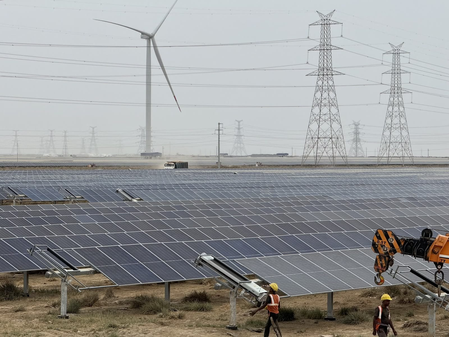
Gandhinagar, July 9 (IANS) Gujarat accounts for the largest share of India’s installed renewable energy capacity, contributing 17.82 per cent of the national total, with the state’s cumulative renewable energy capacity reaching 50.386 GW, according to figures released on Thursday ahead of ‘Global Energy Independence Day’, observed annually on July 10.
The day is marked to promote a transition from fossil fuels to cleaner and more sustainable sources of energy.
India has set a target of achieving net-zero carbon emissions by 2070 and has committed to meeting 50 per cent of its electricity requirements from renewable energy sources by 2030.
Gujarat’s latest renewable energy figures underline the state’s role in meeting those national objectives.
According to the state government, Gujarat has the highest installed wind power capacity in the country at 15,850.56 MW and ranks second in installed solar power capacity with 32,302.7 MW.
The state also leads India in rooftop solar deployment, with more than 13 lakh installations having a combined capacity of 7,408.10 MW.
The state’s total installed solar capacity of 32,302.7 MW, as of May this year, comprises 23,259.27 MW from ground-mounted projects, 7,408.10 MW from rooftop solar systems, 1,434.66 MW from hybrid projects and 200.48 MW from off-grid systems, including installations under the PM-KUSUM scheme.
Among Gujarat’s major solar parks are Charanka with an installed capacity of 749 MW, Radhanesda with 700 MW and Dholera with 300 MW.
The Khavda Renewable Energy Park in Kutch, planned to have a capacity of 37.35 GW, is described by the government as the world’s largest green energy project.
By May, projects with a combined capacity of 15.54 GW had been commissioned at the site.
The government said rooftop solar adoption has accelerated since residential incentive schemes were introduced in 2016 and has continued following the launch of the PM Surya Ghar scheme.
Gujarat now accounts for more than 21 per cent of all rooftop solar installations in the country.
In the agriculture sector, 22,792 standalone off-grid solar water pumps with a combined capacity of 162.62 MW had been installed under Component B of the PM-KUSUM scheme by May.
Gujarat also continues to lead the country in wind energy. Of the state’s installed wind capacity of 15,850.56 MW, Kutch contributes 8,191.42 MW.
Other districts with significant installed capacity include Jamnagar (1,986.15 MW), Devbhumi Dwarka (1,343.24 MW), Amreli (992.90 MW), Rajkot (869.60 MW), Bhavnagar (626.20 MW), Morbi (612.10 MW), Surendranagar (500.60 MW) and Patan (208.20 MW).
The state has also commissioned 2,838.07 MW of wind-solar hybrid projects under the 2018 Hybrid Policy and the Gujarat Renewable Energy Policy 2023.
According to the state government, more than 80 per cent of wind turbines have been installed on government-allotted land, while the Akshay Urja Setu online portal has been introduced to streamline grid connectivity for renewable energy projects.
The state government estimates that growth in the renewable energy sector has generated around 2.37 lakh direct and indirect jobs across the state.
It attributed the expansion of the sector to a series of policy initiatives over the past three decades, beginning with Gujarat becoming the first state in India to introduce a Wind Power Policy in 1993.
This was followed by solar energy policies in 2009, 2015 and 2021, the Waste-to-Energy and Small Hydel Policy in 2016, the Wind-Solar Hybrid Policy in 2018, the revised Waste-to-Energy Policy in 2022 and the Gujarat Integrated Renewable Energy Policy 2025, which came into effect on December 24, 2025, and will remain in force until December 31, 2030.
The Integrated Renewable Energy Policy provides a common framework for solar, wind, hybrid, decentralised renewable energy projects and battery energy storage systems.
It also includes measures to simplify grid connectivity, encourage the repowering of ageing wind projects, promote battery storage integration, renewable energy manufacturing and recycling, group and virtual net metering, agricultural and rooftop solar projects, private sector participation and green skills development.
As of May, Gujarat had 1,531 renewable energy projects under implementation, including 1,320 solar projects with a combined capacity of 3.377 GW, 115 wind projects with 3.913 GW and 96 hybrid projects totalling 4.869 GW.
During the RE-INVEST 2024 event held in Gandhinagar, Gujarat set a target of achieving 105 GW of renewable energy capacity by 2030.
According to the state government, this would contribute around one-fifth of India’s national goal of installing 500 GW of non-fossil fuel energy capacity by the end of the decade.
–IANS
mys/khz