Radio Brisvaani

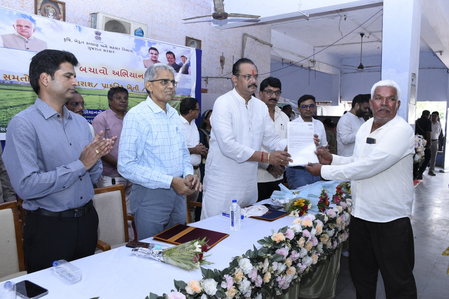
Gandhinagar, June 1 (IANS) Gujarat has launched a month-long statewide ‘Save Farm Campaign’ with an emphasis on reducing chemical inputs in agriculture and expanding natural farming practices, as the state government seeks to address concerns over declining soil fertility and rising health risks linked to intensive farming methods.
The campaign was launched from Shertha village in Gandhinagar district by Agriculture Minister Jitu Vaghani and will be conducted across the state from June 1 to June 30.
Under the programme, teams of agricultural scientists, departmental officers and field staff will visit villages to educate farmers on sustainable farming practices, balanced fertiliser use and alternatives to chemical-based cultivation.
Addressing farmers and livestock rearers at the launch, Vaghani said agriculture must be viewed as a shared heritage and a responsibility for future generations.
“If we do not save our agricultural land today, the future of humanity will not be secure,” he said, adding that the initiative was intended as a long-term effort to protect both livelihoods and food systems rather than a routine government programme.
He expressed concern over what he described as “indiscriminate use” of chemical fertilisers such as urea and DAP and pesticides, stating that it had gradually reduced soil fertility.
“Chemical residues were entering the food chain through crops and animal products, including milk, and this could contribute to serious health issues,” he said.
He referred to a rise in non-communicable diseases such as cancer, diabetes, hypertension and kidney disorders, contrasting current health trends with earlier generations who, he said, faced fewer such conditions.
The Minister urged farmers to begin transitioning to natural farming in a phased manner, suggesting that even adopting the practice on 25 per cent of land initially would be a practical starting point.
He advised farmers to observe results before expanding the practice further, and stressed that chemical fertilisers, where necessary, should be used only in balanced and limited quantities.
“The initiative aligns with the broader vision of Prime Minister Narendra Modi and Governor Acharya Devvrat, both of whom have consistently advocated natural farming as a sustainable alternative. Under the leadership of Chief Minister Bhupendra Patel, around eight lakh farmers in the state have already adopted natural farming, with a target of bringing another five lakh farmers into the system this year,” he said.
He also noted that approximately 20 lakh farmers have so far been trained in natural farming techniques by the Agriculture Department.
To support farmers in marketing natural produce, the state government has introduced certification systems and online sales facilities.
Officials have also been directed to establish regular sale centres at government offices, including collectorates, district panchayat offices, mamlatdar offices and milk cooperative institutions, where natural farming produce such as fruits, vegetables and grains will be sold on designated days each week.
Vaghani also referred to the observance of World Milk Day, noting that India accounts for around 25 per cent of global milk production, with Gujarat playing a leading role in the sector.
“The government’s broader policy encourages farmers to combine agriculture with animal husbandry to increase income, improve milk quality and promote public health,” he said.
Agriculture Department Principal Secretary R.C. Meena said fertilisers were being provided at subsidised rates to support farmers, but their excessive use was causing long-term damage to soil health.
Comparing overuse of fertilisers to a medical overdose, he said both could be harmful.
He urged farmers to adopt modern alternatives such as nano urea and nano DAP, and confirmed that departmental teams and agricultural scientists would continue visiting villages under the campaign to provide guidance on seed quality and balanced input use.
During the programme, assistance under the ‘Mukhyamantri Pak Sanghra Structure Yojana’ was distributed to selected progressive farmers.
Farmers doing natural farming were also felicitated with shawls and certificates of appreciation.
–IANS
mys/rad