Radio Brisvaani

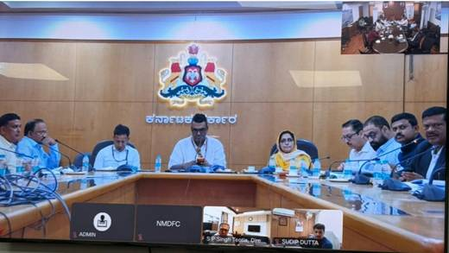
New Delhi, April 30 (IANS) Accelerating project execution and improving outreach of welfare schemes for minority communities topped the agenda at a meeting chaired by the Union Minority Affairs Secretary Srivatsa Krishna on Thursday with Karnataka government officials.
Krishna reviewed the implementation and progress of various flagship schemes of the Ministry, including Pradhan Mantri Jan Vikas Karyakram (PMJVK), Pradhan Mantri Virasat Ka Samvardhan (PM VIKAS), scholarships, UMEED Scheme and other initiatives aimed at socio-economic empowerment and infrastructure development, an official statement said.
During the meeting, Karnataka Secretary Shamla Iqbal presented a detailed overview of the initiatives being undertaken by the state government under the schemes of the Ministry of Minority Affairs.
“Discussions focused on accelerating project execution, improving outreach and ensuring that the benefits of the schemes reach the grassroots level in a timely and transparent manner,” an official statement said.
Krishna directed all officials to expedite ongoing projects and encouraged the state government to come forward with innovative and impactful proposals for new projects under various schemes of the Ministry.
He emphasised the importance of coordination between the Centre and the state for achieving inclusive growth and empowering minority communities through education, skill development, infrastructure and welfare initiatives.
Joint Secretary Ram Singh and Shyama Prasad Roy, Director Neha Giri and senior officials from the Ministry of Minority Affairs and the Karnataka government were also present during the meeting.
PMJVK is a centrally sponsored scheme for creation of community infrastructure in the minority concentration areas of the country in the sectors viz. health, skill development, education, women centric projects, drinking water and supply, sanitation, sports, renewable energy, tourism, animal husbandry and other community infrastructure.
The PMJVK is a demand-driven scheme and no state/Union Territory (UT)-wise financial allocation is made.
Projects are sanctioned based on proposals received from the states/UTs and their readiness for implementation.
An evaluation study conducted by NITI Aayog (2020–21) found that PMJVK has contributed meaningfully to reducing development gaps in the identified areas by creating community assets such as additional classrooms, school buildings and hostels; community health centres and primary health centres; ITIs, polytechnics and skill training centres and women-centric facilities and other critical infrastructure.
–IANS
rch/khz