Radio Brisvaani

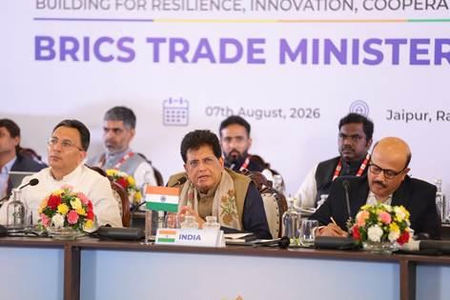
Jaipur, Aug 7 (IANS) India successfully concluded the 16th BRICS Trade Ministers’ Meeting in Jaipur on Friday under its BRICS Chairship 2026, with member nations adopting the Joint Declaration, four key annexes and finalising the Strategy for BRICS Economic Partnership 2030 for submission to BRICS Leaders at the New Delhi Summit.
The meeting, held at Sawai Man Mahal, was chaired by Union Commerce and Industry Minister Piyush Goyal and attended by Minister of State for Commerce and Industry Jitin Prasada, Commerce Secretary Rajesh Agrawal and trade ministers and senior representatives from all BRICS member countries.
Held under the theme Building for Resilience, Innovation, Cooperation and Sustainability, the ministerial meeting focused on strengthening multilateral trade, resilient global value chains, MSME development and expanding trade in goods and services. A key achievement for India was securing strong support for the interests of developing countries, particularly on food security, public stockholding and Special and Differential Treatment within the multilateral trading system.
The Joint Declaration reaffirmed commitment to a development-oriented, rules-based global trading system with the World Trade Organization (WTO) at its core and called for restoring a fully functional dispute settlement mechanism.
Addressing the meeting, Union Minister Piyush Goyal said BRICS represents a growing share of the global economy and cooperation among member nations is essential to address rising protectionism and economic fragmentation. He reiterated India’s commitment to strengthening the multilateral trading system, diversifying global value chains, promoting digitally delivered services and improving access to trade finance for MSMEs.
Minister of State Jitin Prasada welcomed delegates to Jaipur, highlighting India’s tradition of hospitality and Prime Minister Narendra Modi’s vision of “Humanity First,” while emphasising that BRICS cooperation should benefit small businesses, women entrepreneurs and youth across developing economies.
The ministers also adopted the Jaipur Consensus, which proposes studying a BRICS Invoice Discounting Mechanism to bridge the global trade finance gap. They approved the Guiding Principles for Credit Assessment Frameworks for Export-Oriented MSMEs, aimed at improving access to finance by evaluating businesses based on cash flows rather than only collateral.
To strengthen economic cooperation, the meeting adopted a work plan on resilient and diversified Global Value Chains (GVCs), promoting collaboration among Special Economic Zones, digitisation of trade documents and deeper industrial cooperation. The ministers also approved the BRICS Principles to Facilitate Digitally Delivered Services Across Borders, paving the way for greater cross-border digital trade.
A landmark outcome of the meeting was the finalisation of the Strategy for BRICS Economic Partnership 2030, covering trade, investment, digital economy, industry, innovation, financial cooperation and sustainable development. The strategy will be presented for endorsement by BRICS Leaders at the New Delhi Summit scheduled for September 2026.
The successful conclusion of the Jaipur meeting marks a significant milestone under India’s BRICS Chairship. It reinforces the country’s commitment to an open, inclusive, transparent, equitable and rules-based global trading system while advancing the interests of farmers, MSMEs and emerging economies.
–IANS
arc/dan