Radio Brisvaani

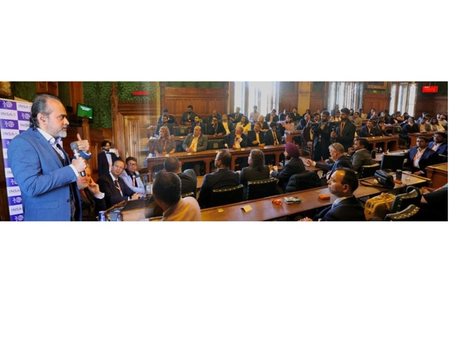
London, June 14 (IANS) Philosopher and author Acharya Prashant addressed a special gathering at the House of Lords in the British Parliament on June 12. Speaking as the Chief Guest on the theme “Indian Roots, Global Wings”, he presented the message of Indian philosophy and Vedanta in a global context.
He said that true Indianness lies beyond culture, tradition, festivals, or cuisine, and that India’s real identity rests on her emphasis on self-knowledge pursued through self-enquiry, the fundamental question, “Ko’ham?” – “Who am I?”
Acharya Prashant delivered his address within the Palace of Westminster, the seat of the British Parliament, which over the decades has been the setting for landmark addresses by some of the world’s most distinguished figures, among them Queen Elizabeth II, Pope Benedict XVI, Nelson Mandela, Ronald Reagan, Bill Clinton, Barack Obama, and General Charles de Gaulle.
The audience included British policymakers, parliamentarians, educators, students, and public representatives from a range of fields. Among the dignitaries present were Lord Bilimoria (Karan Bilimoria, Baron Bilimoria of Chelsea), a crossbench peer and Chancellor of the University of Birmingham from 2014 to 2024; Lord Nagaraju (Baron Nagaraju of Bloomsbury), a Labour life peer and founder of AI Policy Labs and the Mahatma Gandhi Future Leaders Programme; Barry Gardiner, Labour Member of Parliament for Brent West; Indian Deputy High Commissioner Kartik Pande; and Amit Tiwari, National President of INSA.
As Chief Guest at this august gathering, Acharya Prashant illuminated the audience with the contemporary and global implications of the Upanishadic verse “Asato Ma Sad Gamaya.”
Acharya Prashant said that Indian roots are not merely a matter of cultural identity but represent a rigorous commitment to self-exploration. It is from this honest enquiry, he observed, that Vedanta, the Buddha, Saint Kabir, and other major Indian philosophical streams have emerged.
He noted that global expansion and success are often mistaken for freedom, whereas real freedom does not come from external achievement but from recognising and dropping one’s inner bondages.
Reciting the Upanishadic prayer “Asato Ma Sad Gamaya, Tamaso Ma Jyotir Gamaya, Mrityor Ma Amritam Gamaya” in the chamber, he delved deep into its meaning. He explained that it is not a religious or sectarian expression but a call to all of humanity for an inner journey. from untruth to truth, from darkness to light, and from death to the deathless.
He also invoked the Katha Upanishad’s summons, “Uttishthata Jagrata, Prapya Varan Nibodhata”; arise, awake, and learn from the wise, and the method of negation, “Neti Neti,” not this, not this. Returning to the ancient Vedic call of “Charaiveti, Charaiveti”: keep moving, keep moving, he cautioned that the seeker must never settle into or identify with any external symbol, whether of ambition or tradition. Such identities, he said, are resting places the ego clings to; honest enquiry keeps moving and refuses them all. India’s real message, he said, is of outward expansion arising from inner dissolution.
Speaking to IANS just outside the Parliament premises, Acharya Prashant turned to the climate crisis. “For example, the climate crisis is a problem of the human being’s internal order, and lawmakers have to acknowledge that. It is not an emissions problem. It is a consciousness problem.” Such crises: climate change, social fragmentation, mental unrest, all have their roots in the inner disorder of human beings, he argued, and cannot be solved through laws, policies, and technological measures alone.
Referring to his recent dialogues at the Universities of Cambridge and Oxford and now the British Parliament, he remarked, “The truth is not a product that I can redesign differently for different markets.”
Language and presentation may vary with the audience and setting, he clarified, but truth itself does not change.
On the relationship between Vedanta and modern science, he observed that both converge on a single question: “For whom?” Science studies objects; Vedanta investigates the knower who experiences all objects.
On his upcoming climate engagements, he added, “What I’m saying is that without mass self-education, you are not going to succeed.” Green technologies, policies, and economic measures may be necessary, he said, but they cannot be sufficient unless they address the limitless human urge to consume.
This address marks another milestone in Acharya Prashant’s wider UK tour. He earlier spoke at the Cambridge Union as part of the Cambridge India Business Dialogue 2026 and delivered an extensive philosophical lecture on the Isha Upanishad at Oxford University.
In the coming weeks, he will address audiences at the London School of Economics (LSE) and King’s College London, and lead multiple sessions during London Climate Action Week (June 20–28). He was recently honoured at the Kathmandu Kalinga Literary Festival 2026 for his book Truth Without Apology.
Acharya Prashant, founder of the PrashantAdvait Foundation, described his UK tour as an effort to meet global problems with the philosophy of the self. India’s greatest contribution, he said, is not its cultural symbols but a self-knowledge that remains indispensable to all of humanity.
–IANS
skp/