Radio Brisvaani

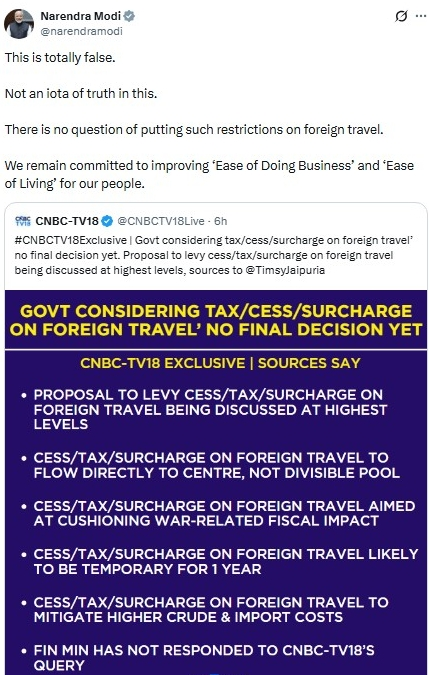
New Delhi, May 15 (IANS) Prime Minister Narendra Modi on Friday took to social media to rebut a source-based media report claiming that the government was considering imposing a levy on foreign travel “at highest levels”.
“This is totally false. Not an iota of truth in this,” the Prime Minister said in posts shared on social media platforms including X and Facebook.
“There is no question of putting such restrictions on foreign travel. We remain committed to improving ‘Ease of Doing Business’ and ‘Ease of Living’ for our people,” he added.
The Prime Minister attached to his post a graphic circulated by business news channel CNBC-TV18, which claimed that the government was considering imposing a “tax/cess/surcharge on foreign travel” and that a final decision was awaited.
Describing the report as an “exclusive”, the channel cited unnamed sources claiming that the proposal was being “discussed at highest levels”.
The report further claimed that the proposed additional levy on foreign travel would “flow directly to Centre, not divisible pool” and was aimed at cushioning “war-related fiscal impact” as well as mitigating higher crude oil and import costs.
The report also stated that CNBC-TV18 had approached the Finance Ministry for confirmation but had not received a response.
However, the Prime Minister categorically dismissed the claims through his public clarification on Friday.
Since PM Modi appealed to citizens to remain pragmatic and responsible in view of continuing global volatility, Opposition parties have repeatedly alleged “governance failure” and described the situation as an “economic emergency”.
The Prime Minister had earlier issued a seven-point appeal urging citizens to reduce unnecessary fuel consumption, revive work-from-home practices and exercise caution in discretionary spending, including on gold purchases, as a precautionary response to uncertain global conditions.
According to experts, such measures are aimed at preparing the country to withstand prolonged global uncertainty and possible increases in international crude oil and energy prices.
India, which imports nearly 85 per cent of its crude oil requirement, remains vulnerable to fluctuations in global energy prices, which could eventually affect inflation in sectors such as transport, food supplies and logistics.
Several countries have already introduced cost-control measures amid continuing uncertainty in West Asia and concerns over rising energy prices.
BJP leaders, meanwhile, accused the Congress of habitually opposing the Prime Minister and claimed that criticism of precautionary economic measures has become a recurring political strategy.
They argued that PM Modi’s appeal was intended to encourage preparedness before economic pressures intensified further.
The Prime Minister’s rebuttal also drew attention to concerns over publication of unverified reports relating to sensitive economic policy matters.
–IANS
jb/pgh