Radio Brisvaani

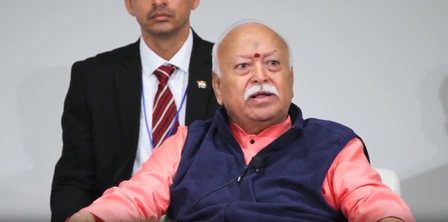
New York, Aug 30 (IANS) Rashtriya Swayamsevak Sangh (RSS) Chief Mohan Bhagwat has said politics has become a “game of self-interest” and added that lasting change must begin within society before it can influence governments and public policy.
Addressing religious leaders at the “One World, One Humanity” programme in New York, Bhagwat added that political action alone could not create unity or change deeply rooted social attitudes.
“These things do not happen through politics. Sorry to say, but the fact is, politics has now become a game of self-interest,” the RSS Chief said.
He added that the emphasis on individual interests had made it harder to find solutions to social divisions.
Collective thinking, he said, offered a better path.
“Where there is me, I am I. There is no solution. We and ours is the solution,” he added.
“So our experience in Bharat is that we have to start with the society.”
Bhagwat said religious leaders ultimately wanted to influence political decisions, prevent wars and encourage governments to pursue the right policies.
But such efforts, he added, could not begin at the political level.
“We want to change, influence the policies before they happen, influence them in the right way. We want to stop wars, we want to do all these things,” he said.
“Therefore we want to influence the politics. We have to at some point of time. But we cannot start with those.”
Bhagwat said the process should begin by building public opinion through dialogue, service and practical examples of cooperation.
Democratic governments, he said, depend on the views of citizens.
“Politics today, especially in democracy, it depends on the public view,” he said.
“If there is public opinion, then no politician will dare to go against it.”
Bhagwat urged participants to take their common commitments back to their countries and begin working within local communities.
“Whatever we decide to do today, we should start in our own country and create pockets of such selfless service, such atmosphere of unity,” he said.
The RSS Chief said communities should develop working models of the kind of world they wanted to build.
These efforts should then be connected through sustained dialogue, he added.
“We should create at our own place the models of the world we want,” Bhagwat said.
“And we should connect. We should keep on this dialogue.”
He called for interfaith engagement to move beyond senior religious leaders and reach communities at the provincial, district and block levels.
“If we start at this level and start instructing our own people and then try to have this dialogue in all the countries, in the provinces of those countries, district level, block level, if you go like that, then the atmosphere will change,” he said.
Bhagwat cautioned that changing public attitudes would be a long and difficult process.
Knowledge alone, he said, was insufficient unless it shaped conduct and daily practice.
“If we together start working, we can change the situation of the world,” he said.
“But it will take long time. It is not so easy to clean up public mind.”
Bhagwat has led the Rashtriya Swayamsevak Sangh since 2009. The Sarsanghchalak (Chief) is the organisation’s highest-ranking office-bearer and provides its broad ideological and organisational direction.
Founded in Nagpur in 1925 by K.B. Hedgewar, the RSS marked its centenary in 2025. It describes itself as a volunteer-based cultural organisation and has a nationwide network of local branches and affiliated bodies.
–IANS
int/lkj/khz