Radio Brisvaani

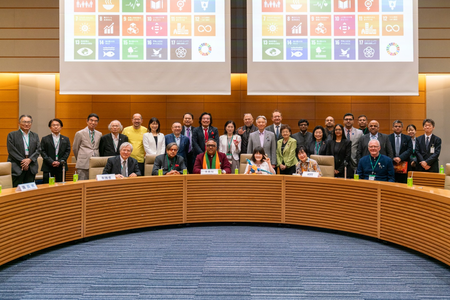
Tokyo, July 1 (IANS) On the eve of the visit of Japanese Prime Minister Sanae Takaichi to India, Professor C. Raj Kumar, Founding Vice Chancellor of O.P. Jindal Global University (JGU), and Dr Shashi Tharoor, Member of Parliament, addressed a distinguished bipartisan gathering of Members of the National Diet of Japan at the National Diet Building in Tokyo.
The significance of the interaction was heightened by coinciding with the official visit of the Prime Minister of Japan, Sanae Takaichi, to India and the India-Japan Annual Summit with Prime Minister Narendra Modi. As both governments continue to deepen their Special Strategic and Global Partnership at the highest political level, the discussions in Tokyo demonstrated that enduring bilateral relationships are strengthened not only by governments but also by parliaments, universities, scholars, students, industry, and civil society.
The interaction was chaired by Fukushiro Nukaga, the 80th Speaker of the House of Representatives of Japan, and brought together an exceptional and bipartisan gathering of Members of the National Diet representing both the House of Representatives and the House of Councillors.
The meeting was attended by senior parliamentary leaders, former ministers, government representatives, eminent diplomats, distinguished academics, policy experts, and industry leaders from across Japan. The breadth of participation reflected Japan’s strong bipartisan commitment to strengthening parliamentary dialogue, educational cooperation, democratic engagement, innovation, and institutional partnerships with India.
“Asia’s evolving geopolitical landscape demonstrates that the strongest international partnerships are patiently built through sustained investments in education, research, technology, human capital, institutional cooperation, and innovation. India and Japan, he said, possess a unique opportunity to deepen their relationship further by investing in universities, scientific collaboration, entrepreneurship, academic mobility, and knowledge partnerships,” He said.
He called for a future in which Indian and Japanese universities work even more closely together, researchers jointly address global challenges, students move more freely between both countries, and governments, industry, and academia collectively develop solutions for the Indo-Pacific and beyond. Such investments, he argued, create relationships that are resilient because they are founded not only on policy but also on people.
Highlighting JGU’s own engagement with Japan, Prof Raj Kumar noted that the University’s partnerships with 27 leading Japanese institutions and the participation of nearly 200 students in study abroad programmes across Japan reflect a sustained institutional commitment to building long-term academic cooperation. These partnerships have strengthened student mobility, faculty collaboration, joint research, innovation, and intercultural understanding, demonstrating how universities can serve as enduring bridges between nations.
Professor Raj Kumar observed that higher education has become one of the defining pillars of contemporary India–Japan relations because universities cultivate trust, mutual understanding, leadership, and lifelong friendships that strengthen bilateral cooperation across generations.
Shashi Tharoor reflected on the equally important role of parliamentary diplomacy and observed that diplomacy is not merely about negotiating interests or responding to crises. At its finest, he said, diplomacy preserves memory, reflects mutual respect, and inspires nations to imagine and build a better future together.
Reflecting on the centuries-old relationship between India and Japan, Tharoor said, “The friendship between the two countries has been nurtured through Buddhism, cultural exchange, democratic values, and deep civilisational respect. This shared history is not only a source of pride but also a responsibility. The challenge before both nations is not to create a new friendship but to continually renew and strengthen an enduring one through institutions capable of serving future generations. While governments create strategic partnerships, it is ultimately people who sustain them. The future of India-Japan relations will depend as much upon the relationships built among students, scholars, parliamentarians, entrepreneurs, artists, innovators, scientists, and citizens as upon agreements signed by governments. These enduring human connections transform strategic cooperation into lasting partnership.”
Members of the National Diet spoke warmly of their longstanding engagement with India and expressed admiration for India’s civilisational heritage, democratic traditions, constitutional institutions, economic transformation, and expanding global role. They reaffirmed their commitment to strengthening parliamentary exchanges, educational partnerships, academic collaboration, scientific research, innovation, and people-to-people ties between the two democracies.
At a time when India and Japan are engaging at the highest political level to shape the future of their Special Strategic and Global Partnership, the interaction in Tokyo served as a timely reminder that governments alone cannot build enduring international relationships. Universities, parliaments, scholars, researchers, entrepreneurs, and civil society together provide the institutional foundations that enable strategic partnerships to flourish across generations.
The interaction was chaired by Fukushiro Nukaga, the 80th Speaker of the House of Representatives of Japan, and brought together an exceptionally distinguished and bipartisan gathering of Members of the National Diet of Japan, senior parliamentary leaders, former ministers, government representatives, policy experts, academics, and industry leaders.
–IANS
skp/