Radio Brisvaani

New Delhi, May 26 (IANS) Former head coach of the Indian men’s basketball team and FIBA, Veselin Matic, believes India’s school ecosystem can become the foundation for long-term basketball development, provided the focus shifts towards structured coaching, regular competitions, and stronger grassroots systems.
Matic, who is leading the PE Educators Upskill Program launched by International Schools Sports Organisation (ISSO) Academy in collaboration with FIBA (International Basketball Federation) and International School Sport Federation, said India’s sporting structure differs significantly from Europe and other major basketball nations.
“Europe is made up of many different countries, so the systems vary. But in most top basketball nations in Europe, especially in the Balkans, including Serbia, Slovenia, Croatia, Bosnia, Montenegro, and Macedonia, development mainly happens through clubs and private academies rather than schools,” Matic told IANS.
“But in India, I feel the school system is much stronger than the club system. In my opinion, the club structure here is weak, while schools have a far better setup. Schools have teachers and specialists for different sports, such as basketball, football, cricket, athletics, and that gives them an advantage. School facilities are also much better than club facilities in India,” he added.
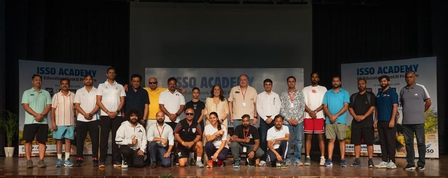
The PE Educators Upskill Program, being held from May 25 to June 2, has selected 15 PE educators from across the country. The initiative aims to improve grassroots sports education through structured training for coaches and educators.
Matic, who coached India from 2019 to 2025, believes the programme can become an important long-term investment for Indian basketball if schools create sustained competitive structures.
“Children go to school for education, but usually the class they enjoy the most is sports. When students get selected to represent their school, they feel proud. If schools can organise weekly matches over a period of three, four, or five months, where students regularly compete against other schools, it can gradually take school sports to the next level. For that, you need structure — and schools already have structure,” he said.
The Serbian coach, who was part of the coaching staff that guided FR Yugoslavia to the EuroBasket 2001 and 2002 FIBA World Championship titles, stressed that training programmes alone cannot transform Indian basketball unless they are backed by regular competition. “Many good schools already have basketball coaches, but without regular games and competitions, development is impossible. Training alone is not enough. Properly organised tournaments and competitions are essential for growth,” he said.
Matic also pointed to a major structural issue within Indian basketball: the lack of continuity after talent is identified at a young age.
“In my opinion, the key issue is selection and long-term development. Children should start early — ideally between the ages of six and seven. Mini basketball programmes from ages six to 12 are extremely important and must be organised properly. But after the age of 15, there has to be another level of selection. Not every player will continue in basketball. Basketball is a sport where height and physical development become very important after a certain age,” he explained.
According to Matic, India currently lacks a strong second-stage development system for players between the ages of 16 and 19. “What India is missing is this second-stage development system after the age of 15. Out of 12 or 15 players in a youth team, maybe only two or three will eventually reach the next level. The best talents must be identified, brought together, and developed properly,” he said.
Matic also expressed concern over age-fraud issues in junior competitions and the excessive emphasis on winning age-group tournaments. “The focus should not simply be on winning tournaments. In India, certificates and titles often help people secure jobs later, so some coaches become too focused on results instead of genuine player development. That mentality has to change,” he said.
The programme is part of ISSO Academy’s broader push to strengthen school sports ecosystems in India through international collaborations. Earlier this year, ISSO also organised PE Educator and Coach Development Programmes in partnership with the Badminton World Federation.
Speaking about the vision behind the collaboration, Akanksha Thapak, ISSO Director, said the initiative aims to improve the quality of PE education at the grassroots level.
“We have always believed that sport is an ecosystem. It is never just about one player participating in a tournament. The ecosystem begins with coaching, and coaching begins in schools. PE educators are the main framework for that. What we feel is that PE education in India is still lagging behind international standards, and that is one reason why growth at the grassroots level is not happening as it should,” she told IANS.
Thapak said basketball has emerged as one of the fastest-growing sports among children in India, making the collaboration with FIBA especially significant. “There is a lot of interest in the sport, and that is why this collaboration becomes important,” she said.
She also highlighted that the seven-day programme focuses not just on technical coaching but also on athlete welfare and mental development. “It teaches PE educators how to train athletes properly, how to guide them through instructions, how to help them play better, and even how to help them cope with mental stress,” she said.
On the changing perception of sports careers in India, Thapak noted that parents today are becoming more accepting of sports as a profession. “There are more career opportunities in sports, including analytics, management, and other areas within the sports ecosystem. Parents today are far more open to accepting sports as a profession. There are already many scholarship programmes being introduced, and even we support such initiatives as part of our CSR activities,” she noted.
For ISSO, the long-term objective is to create a sustained and structured learning ecosystem within schools.
“With the PE educators’ programme, we believe educators at the school level will learn the correct methods and systems. There will also be follow-up programmes to ensure continuity. Otherwise, it becomes a situation of ‘learn today, forget tomorrow,’” Thapak stated.
–IANS
bsk/