Radio Brisvaani

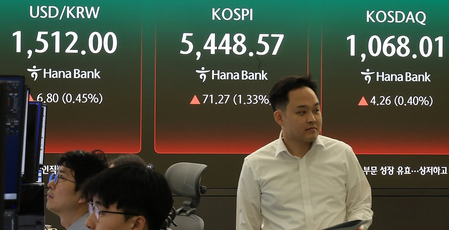
Seoul, April 20 (IANS) Seoul stocks were trading sharply higher late on Monday morning, despite concerns over renewed tensions between the United States and Iran in the Middle East.
The benchmark Korea Composite Stock Price Index (KOSPI) gained 81.79 points, or 1.32 percent, to 6,273.71 as of 11:20 am (local time), reports Yonhap news agency.
U.S. President Donald Trump has said the U.S. has seized an Iranian-flagged commercial vessel in the Gulf, as part of its naval blockade. Iran called such acts as a violation of the ceasefire.
Investors are keeping a watch on a possible second round of peace talks between the U.S. and Iran amid reports that Iran’s state media say that Tehran has no plans to participate.
In Seoul, most large-cap shares were trading higher.
The country’s major chipmakers, Samsung Electronics and SK hynix, gained 0.93 percent and 3.72 percent, respectively. SK hynix is set to release its first-quarter earnings this week.
Defence giant Hanwha Aerospace added 0.35 percent, major financial firm KB Financial inched up 0.12 percent, while top car maker Hyundai Motor fell 0.37 percent.
The local currency was quoted at 1,474.1 won against the U.S. dollar, up 9 won from the previous session.
Meanwhile, outgoing Bank of Korea (BOK) Gov. Rhee Chang-yong said on Monday that achieving economic stability and growth through monetary and fiscal policy alone has become increasingly difficult, calling for a broader role for the central bank in addressing long-term structural challenges.
Rhee made the remarks during his farewell ceremony in Seoul, as he completed his four-year term. Governor-designate Shin Hyun-song is set to begin his term Tuesday if his nomination is approved by the parliament later in the day.
“Despite the weakening influence of monetary and fiscal policy on achieving stability and growth amid structural changes in the economy, public expectations for policymakers remain high based on past successes, widening the gap between the two,” Rhee said.
“Though recent economic and foreign exchange conditions have been relatively stable thanks to the semiconductor boom, it is difficult to view this entirely positively, as it also highlights deepening structural problems, such as excessive reliance on specific industries and resulting polarisation,” he added.
—IANS
na/