Radio Brisvaani

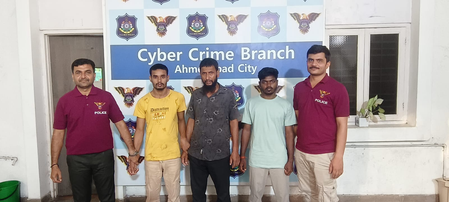
Ahmedabad, May 8 (IANS) The Ahmedabad Cyber Crime Branch has arrested three more alleged individuals in an inter-state cyber fraud racket that police say used artificial intelligence-generated deepfake videos to manipulate Aadhaar authentication systems, illegally change registered mobile numbers and obtain loans in the names of unsuspecting victims by hijacking their digital identities.
The latest arrests bring the total number of accused in the case to seven, while one accused, Oli Ullah from Assam, remains absconding.
The case was registered at the Cyber Crime Police Station, Ahmedabad City, under Bharatiya Nyaya Sanhita, 2023 Sections 61(2)(a), 336(2) and 336(3), along with Sections 43(a), 43(b), 43(i), 66 and 66(C) of the Information Technology Act, following a complaint that unknown persons had illegally obtained personal data, altered Aadhaar-linked mobile numbers and used forged identities to open bank accounts and obtain loans.
According to the Cyber Crime Branch, the accused gained unauthorised access to platforms and services, including the National Informatics Centre’s DigiLocker, UIDAI Online Services, IDFC Bank, Kotak Mahindra Bank, City Union Bank, and Jio Payments Bank, by manipulating biometric and demographic records and creating forged electronic documents.
Police identified the newly arrested accused as Krishna Prajapati, 22, a resident of Kushinagar district in Uttar Pradesh; Kazimuddin, 49, from Morigaon district in Assam; and Rabbul Hussain, 24, also from Morigaon district.
Both Kazimuddin and Rabbul are the masterminds behind the fraud network.
Officials said four accused had already been arrested earlier in the investigation.
Investigators alleged that the gang targeted financially stable individuals by using GST-related platforms such as MastersIndia and Peridot to obtain GST numbers and PAN card details.
The accused then allegedly used PAN information to access CIBIL reports through CRIF High Mark and retrieve mobile numbers linked to victims.
Police said the accused used Telegram bots to identify Aadhaar-linked mobile numbers and collected photographs of victims from digital payment and social media platforms, including PhonePe, Google Pay, WhatsApp, Truecaller, Facebook and Instagram.
Using AI platforms, including Gemini and Meta AI, the accused allegedly created “eye-blinking” deepfake videos from static photographs to mimic live facial movements and bypass Aadhaar biometric verification systems linked to Aadhaar UCL kits.
“The accused used highly advanced techniques to bypass digital verification systems. They created AI-generated eye-blinking videos from Aadhaar photographs to mimic live biometric authentication,” a Cyber Crime Branch officer said.
Investigators said the gang exploited loopholes in digital identity verification systems by using CSC centres to submit requests for changing Aadhaar-linked mobile numbers.
Once the registered mobile number was replaced with a SIM card controlled by the accused, they allegedly gained access to DigiLocker accounts, OTPs, Aadhaar-enabled services and banking platforms connected to the victim’s identity.
Cyber Crime DCP Dr Lavina Sinha said the accused manipulated Aadhaar-linked mobile numbers to obtain full access to victims’ digital records and financial services.
“Once the mobile number was changed, they gained full access to DigiLocker and banking services. They then opened bank accounts, took personal loans and transferred the money across multiple accounts,” she said.
Police said the accused then opened multiple bank accounts and obtained instant personal loans, usually ranging from Rs 25,000 to Rs 50,000, before routing the money through several bank accounts to avoid detection.
Investigators said the racket generated annual revenue of nearly Rs 10 lakh to Rs 15 lakh through fraudulent loan transactions.
According to police, the accused also carried out KYC verification, updated mobile numbers, and changed the email IDs linked to DigiLocker accounts before using forged identities to apply for loans through platforms including RKBANSAL, TRUE CREDITS and EARLYSALARY.
The investigation began after an Ahmedabad businessman complained that he had suddenly stopped receiving OTPs linked to his Aadhaar-enabled payment system.
Initially believing it to be a technical issue, he later discovered that his Aadhaar-linked mobile number and biometric details had allegedly been changed without his knowledge, and loans had been taken in his name.
Police alleged that a local Aadhaar kit operator helped facilitate illegal modifications to Aadhaar-linked records. Investigators said Rabbul Hussain allegedly handled AI tools and digital identity theft operations alongside his associate, Oli Ullah.
Police alleged the pair collected GST and PAN details, retrieved mobile numbers from CIBIL reports, obtained Aadhaar-linked data via Telegram bots, and sourced photographs from online platforms before altering Aadhaar-linked mobile numbers and opening fraudulent bank accounts.
Krishna Prajapati, who police said had studied up to the ITI fitter level and operated a settlement centre business, allegedly supplied the complainants’ Aadhaar numbers, photographs, and mobile data obtained from contacts in Assam to previously arrested accused Deep Gupta in exchange for commission payments.
Kazimuddin, who had studied up to Class 7, allegedly allowed fraudulent loan money obtained by Rabbul Hussain and Oli Ullah to be routed through his bank accounts and received commission for the transactions.
Rabbul Hussain was stated to be pursuing a B.Com degree.
Police said Deep Gupta, accused of forwarding complainants’ data, had earlier been arrested in Kushinagar, Uttar Pradesh, by a team led by PI N.R. Gamit, while the latest arrests in Assam were carried out by PI J.P. Thakor and his team using technical surveillance, digital analysis, and human intelligence.
Police said they have informed Aadhaar authorities of what investigators described as “serious loopholes” in the digital identity verification ecosystem that the gang allegedly exploited.
Officials added that further interrogation of the arrested accused is continuing to identify additional victims and uncover the full extent of the interstate network.
–IANS
mys/dan