Radio Brisvaani

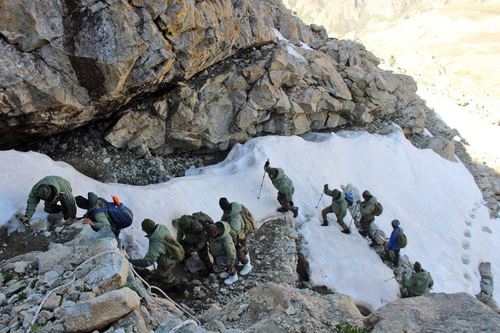
New Delhi, Sep 10: With the release of Oni Sen’s six-part series Operation Safed Sagar on Netflix, streaming audiences have tuned in to watch the formidable high-altitude operations of the Indian Air Force.
The show dramatises the tactical photo-reconnaissance sorties and precision strikes executed by No. 17 “Golden Arrows” Squadron above 20,000 feet, highlighting the cockpit tension, missile locks, and air combat against the Himalayan horizon. Yet alongside this aerial valour lies a crucial strategic narrative: every strike executed by Indian pilots and every ridge reclaimed by infantrymen directly served to shield the vital lifeline running through the valley below.
The 1999 Kargil conflict demonstrated that along high-altitude frontiers, securing sovereignty requires both tactical mastery on the peaks and the absolute protection of lines of communication. Courage on the summits and logistics on the ground are mutually reinforcing elements of military victory.
When Pakistani forces surreptitiously occupied the ridgelines above Dras, Batalik, and the Mushkoh Valley, their primary goal was to bring National Highway 1D under direct observation and artillery fire. Interdicting this single asphalt artery was meant to isolate Ladakh and the approaches to Siachen, cutting off supply lines to forward garrisons.
Recognising this critical vulnerability, the Indian Armed Forces coordinated a joint campaign to secure the corridor. Operation Safed Sagar played an essential role through vertical interdiction. The IAF pilots braved extreme altitudes and ground fire to conduct tactical reconnaissance and precision strikes, destroying key enemy logistics hubs like Muntho Dhalo. By pinning down enemy positions on the heights, the air force created an overhead shield that allowed army supply convoys to navigate NH-1D safely. Air support and ground movement functioned as twin pillars of a single, unified defence effort.
That lines of communication decide campaigns is a familiar claim in modern strategic writing, and it is tempting to treat it as a product of industrial-age logistics. It is older than that. Kautilya set it down with real precision in the Arthashastra, in the thirteenth book on the means of taking a fortified place, more than two thousand years ago.
His sequence is worth following. Against an enemy holding difficult terrain, Kautilya tells the attacker to destroy his stored provisions and standing crops, and to cut his वीवध (vīvadha) and प्रसार (prasāra), which are his lines of supply and his avenues of movement and reinforcement (13.4.6). What follows is deliberate wearing down. By severing communications and provisions, he writes, the enemy suffers प्रकृतिक्षय (prakṛti-kṣaya), which is the gradual exhaustion of the very elements that hold up his power, his troops, his stores, and his morale (13.4.7). This is not the idiom of the decisive charge. It is attrition through denial, making a position impossible to hold rather than storming it.
Kautilya noted that before securing difficult terrain, a commander must first safeguard his own roads and access routes to sustain the effort. Reopening and holding NH-1D was the essential foundation that allowed Indian artillery, including the Bofors guns, to move forward and provide decisive fire support for the infantry. While Indian infantry units displayed incredible heroism storming near-vertical cliffs to retake Tololing and Tiger Hill, securing vīvadha ensured they had the continuous flow of ammunition and rations needed to achieve victory.
The verse that speaks most directly to Kargil, though, is the one on preparation. Before investing a fort, Kautilya insists, the commander must first secure his camp, his supply routes, and his roads: कृत्वा स्कन्धावारस्य रक्षां वीवधासारयोः पथश्च (13.4.9). Only then does the assault begin. Against 1999, the instruction is almost literal. NH-1D (then NH-1A) was exactly such a road. Reopening and holding it was not a task in support of the battle for the heights; it was the condition for that battle to be sustained at all. The Bofors guns whose fire proved decisive had to be moved up that road, as did everything else. Kautilya would have recognised the priority and likely approved of the patience beside it, which was the choice to mass guns, acclimatise troops, and wait for the right conditions before committing them (13.4.8).
The strategic lessons forged by the armed forces in 1999 have directly inspired India’s modern infrastructure push along its northern borders. Historically, harsh winter weather accomplished what the adversary attempted in 1999, as heavy snowfall routinely closed the Zoji La pass at 11,500 feet and isolated Ladakh for nearly half the year. To eliminate this seasonal vulnerability, India has built upon the military’s strategic legacy by engineering robust, year-round transport networks across the region.
The Z-Morh Tunnel opened in early 2025, providing all-weather access to Sonamarg. Behind it, the 14-kilometre Zoji La Tunnel project is designed to deliver permanent, year-round connectivity between Srinagar and Leh. Active winter maintenance by the Border Roads Organisation has already yielded major results, keeping the Zoji La stretch open through February 2025 for the first time in history.
This infrastructure drive extends right across the Line of Actual Control, supported by strategic projects like the 1,840-kilometre Arunachal Frontier Highway. Integrated with airbases modernised after the 1999 war, these resilient transit corridors ensure that the armed forces maintain constant readiness and rapid mobility in all seasons.
The fundamental truth demonstrated during the Kargil Conflict remains vital today. The heroic achievements of soldiers on the peaks and pilots in the skies captured the nation’s respect, while the protection of ground logistics provided the foundation for their triumph. As viewers revisit the dramatic air operations of Operation Safed Sagar, the enduring legacy of 1999 lives on in the concrete, steel, and mountain tunnels that permanently safeguard the nation’s vital frontier arteries.
(The writer is Doctoral Scholar in OP Jindal Global University. Views expressed in the article above are his own.)