Radio Brisvaani

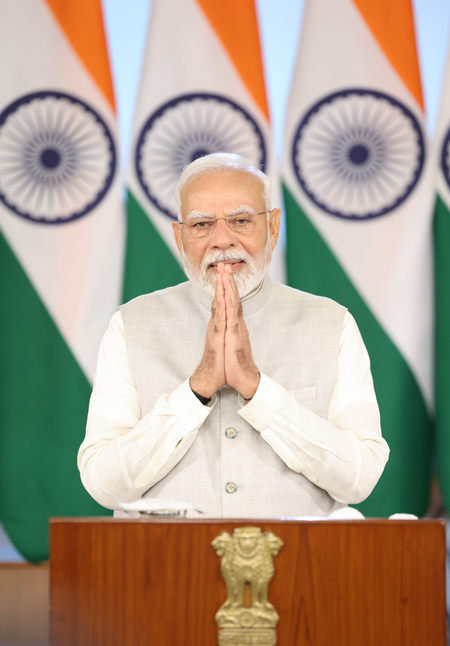
New Delhi, May 16 (IANS) It was on this day in 2014 when India witnessed a seismic shift. The outcomes of the 16th Lok Sabha elections were announced on May 16, 2014, ushering in a new era under the leadership of Prime Minister Narendra Modi. The Bharatiya Janata Party (BJP), leading the National Democratic Alliance (NDA), stormed to power with a massive mandate. The Congress-led UPA government that had ruled for a decade was dislodged.
The 2014 general elections were historic in more ways than one. Held in nine phases from April 7 to May 12, they saw an unprecedented voter turnout and enthusiasm across the country. The BJP secured an absolute majority with 282 seats out of the total 543 in the Lok Sabha, a feat not achieved by any single party since 1984.
It was a clear endorsement of PM Modi’s message of development, governance, and strong leadership.
Taking office on May 26, 2014, Narendra Modi became India’s 14th Prime Minister. The first session of the 16th Lok Sabha was convened from June 4 to June 11, 2014. Senior leader Kamal Nath was sworn in as the pro-tem Speaker and presided over the election of the Speaker of the House. Sumitra Mahajan, one of the longest-serving women parliamentarians, was elected Speaker on June 6, while M. Thambidurai of the AIADMK became the Deputy Speaker on August 13.
One of the immediate outcomes of the BJP’s landslide win was the absence of an official Leader of Opposition in the Lok Sabha, as no party crossed the 10 per cent seat threshold required for recognition. The Congress, once the dominant force in Indian politics, could muster only 44 seats, far below the 55-seat mark needed. The AIADMK, with 37 seats, emerged as the third-largest party. Senior Congress leader Mallikarjun Kharge was named the leader of the Congress in the Lok Sabha.
The mandate of 2014 was not just a vote for change but also a vote of hope — for a resurgent India, better governance, and economic progress. Since that watershed moment, PM Modi has led the nation through a decade of transformative reforms, policy overhauls, and an assertive global stance. Under his leadership, India rose to become the fifth-largest economy in the world, surpassing the UK, and is now firmly on the path towards becoming an economic powerhouse.
In 2019, the Modi-led NDA returned to power with an even stronger mandate, winning 303 seats, reaffirming the public’s trust in his governance. The second term was marked by significant structural reforms, the abrogation of Article 370 in Jammu and Kashmir, the implementation of the Citizenship Amendment Act (CAA), and a comprehensive response to the Covid-19 pandemic, including a massive vaccination campaign and a push for self-reliance under the Atmanirbhar Bharat initiative.
In 2024, the BJP-led NDA once again secured a majority in the Lok Sabha elections, making it three consecutive terms for Narendra Modi — a rare political achievement that places him alongside stalwarts like Jawaharlal Nehru in terms of electoral dominance. This third consecutive mandate is widely seen as a strong endorsement of Modi’s governance model and vision for the future.
On the security front, the world witnessed Prime Minister Narendra Modi’s bold and decisive leadership, particularly in the wake of terror attacks linked to Pakistan. India responded with precision strikes across the border — in Pakistan and Pakistan-occupied Kashmir (PoK) — following the Uri attack in 2016, the Pulwama attack in 2019, and most recently, the Pahalgam attack in 2025. These actions sent a clear message: this is a new India under Prime Minister Modi, one that “strikes back by entering the enemy’s territory”.
Under his leadership, India broke free from the policy paralysis that had gripped the nation during the UPA era. The Modi government has taken bold decisions across key domains — economic, constitutional, legal, and social — demonstrating a commitment to decisive governance. Prime Minister Modi has repeatedly emphasised that the previous regime was guided by vote-bank and appeasement politics, often at the cost of meaningful welfare reforms. In contrast, his administration has prioritised inclusive development and national interest, with visible results on the ground.
Now the PM has bigger and ambitious plans for future of India. He has laid out a gigantic vision: to make India the third-largest economy by 2028, and more importantly, to transform the nation into a “Viksit Bharat” (developed India) by 2047, the centenary year of independence. The Modi government has chalked out multiple initiatives which are aimed at enhancing infrastructure, boosting manufacturing, creating jobs, advancing digital connectivity, and improving the ease of doing business. All these factors are mandatory for a nation’s massive growth trajectory.
On the global stage, PM Modi’s India has also emerged as a confident and assertive voice. From leading G20 negotiations to championing causes such as climate action and digital public infrastructure, India has cemented its status as a key player in global geopolitics.
The journey from May 16, 2014, to today has been marked by decisive leadership, bold reforms, and a consistent focus on development. Whether it is the creation of a new India driven by innovation, infrastructure, and inclusion, or positioning the country as a global voice for the Global South, Prime Minister Narendra Modi’s decade in power has undoubtedly left an indelible mark on India’s political and economic trajectory.
As the nation looks towards the future, the vision of Viksit Bharat 2047 offers a roadmap not just for economic growth, but for a transformation in every sphere of national life — from education and health to defence, diplomacy, and technology. Ten years after that defining day in 2014, India stands poised at the cusp of a new chapter, with confidence, clarity, and continuity at the helm.
–IANS
brt/pgh