Radio Brisvaani

New Delhi, May 8 (IANS) The origins of the Pakistani Armed Forces are rooted in the colonial history of British India. When the Indian subcontinent was partitioned into two sovereign states, India and Pakistan, based on the Muslim League’s ‘Two-Nation Theory’, the division extended beyond territory. Resources and personnel, including the military, were also split. The nascent Pakistani state inherited the Muslim segment of the British Indian Army. While India opted to remain a secular democratic state, Pakistan emerged as a state where the military held significant power. Over time, religion was increasingly used as an ideological tool to motivate forces, particularly in the context of its rivalry with India.
Ayub Khan, who became the first native Pakistani Commander-in-Chief in 1951, was a soldier firmly rooted in the colonial framework and was initially less sympathetic toward religion as an ideological force. However, following his seizure of power, a new generation of nationalist officers emerged. Unlike their predecessors, they had little attachment to the colonial legacy and were driven by nationalist ideas, seeking to transform the Pakistani Army from a colonial institution into a more distinctly national force. This ideological reconfiguration pushed the army to claim continuity with an Islamic past, drawing symbolic links between itself and the armies of early and classical Islamic history. Figures such as Khalid ibn al-Walid, Salahuddin Ayyubi, and Tariq ibn Ziyad, as well as medieval Muslim rulers of the subcontinent like Muhammad Ghori, Mahmud Ghaznavi, and Babur, were elevated as symbolic icons of military heritage.
During the Indo-Pakistani War of 1965, Field Marshal Ayub Khan and Zulfikar Ali Bhutto devised a plan to seize the Indian state of Jammu and Kashmir by force, naming it ‘Operation Gibraltar’. The name deliberately invoked Islamic history, referencing the Arab conquest of Gibraltar in 711 CE led by Tariq ibn Ziyad, framing the operation in a heroic and religiously symbolic light.
A popular myth within Pakistan, both among the general public and segments of its military leadership, holds that “one Pakistani (Muslim) soldier is equal to 10 Indian (Hindu) soldiers,” often attributed to faith and perceived warrior ethos. In line with this ideological orientation, the Pakistani military has named several of its missile systems and offensive capabilities, such as ‘Ghauri’ missile, ‘Babur’ missile, and ‘Ghaznavi’ missile, after historical Muslim figures. This reflects an effort to symbolically connect modern military identity with narratives of medieval Islamic power and continuity.
During the era of General Zia-ul-Haq, the Pakistani armed forces more explicitly projected themselves as defenders of the Islamic faith. This shift was shaped by a combination of organisational dynamics and geopolitical circumstances.
Unlike Ayub Khan, who had observed the Pakistan Movement largely from within military barracks and had little direct engagement with it, Zia’s generation had witnessed the Muslim League’s movement firsthand in college campuses and public spaces. As a result, they developed a different ideological attachment to Pakistan and its military. Many senior officers during this period came from urban, middle-class Punjabi backgrounds, with a significant number, including Zia himself, having migrated from eastern Punjab during Partition.
Building on trends that had begun on a limited scale under Ayub Khan, the ideological reorientation of the Pakistani Army toward identifying itself with the legacy of classical Islamic history accelerated significantly under Zia. Soon after becoming Chief of the Army Staff (COAS), Zia altered the army’s guiding motto. He replaced Muhammad Ali Jinnah’s ‘Iman, Ittihad, Nazm’ (Faith, Unity, Discipline) with ‘Iman, Taqwa, Jihad fi sabilillah’ (Faith, Piety, and Struggle in the path of God). He also characterised the Pakistani soldier as a ‘soldier of Islam’, and part of the ‘Jaish al-Islam’ (Army of Islam).
During this period, religious organisations such as Jamaat-e-Islami and Tablighi Jamaat were given space to operate within the military environment, encouraging greater religious observance among soldiers and officers. Stephen P. Cohen, noted during his field research in the late 1970s and early 80s, that while personal faith had always been an important aspect of officers’ private lives, under Zia it became more institutionalised. An officer’s piety and religious practices increasingly factored into official evaluation and promotion considerations.
Alongside demographic and structural changes within the Pakistani armed forces, geopolitical climate further catalysed the Islamisation in Pakistani society in general and within its military in particular. Following the Soviet invasion of Afghanistan and the US policy of containing communism, Pakistan emerged as a frontline state in the Jihad against the Soviet Red Army in Afghanistan. With support from the Central Intelligence Agency (CIA), the Pakistani Army established numerous training centres along the Afghan border to train mujahideen fighters to wage Jihad to defend their faith and land against the Godless Red Army. This training extended beyond conventional warfare and weapons handling; it also included religious and ideological indoctrination, intended to project Pakistan’s ideological influence into Afghanistan to ensure a friendly government in the future. Taliban was the direct outcome of that ideological indoctrination.
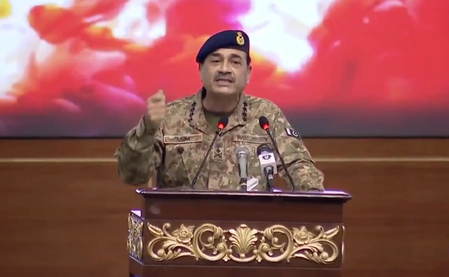
Fast forward to the rise of Asim Munir to the corridors of power. Munir’s elevation is often seen in the context of Pakistan’s evolving “hybrid regime”, in which civilian governments operate alongside significant military influence. In November 2022, he was promoted to the rank of four-star general and appointed Chief of the Army Staff (COAS) amid a ‘perfect storm’ of political upheaval, a deepening economic crisis, and widespread public disillusionment with the military’s role in governance. One of his immediate priorities after assuming office was to neutralise Imran Khan and his party, Pakistan Tehreek-e-Insaf (PTI). Munir himself had previously been removed from his position as Director-General of notorious spy agency, the Inter-Services Intelligence (ISI) after reportedly falling out of favour with Khan.
Asim Munir differs significantly from his predecessors. As a ‘Hafiz-e-Quran’ (one who has memorised the Quran in its entirety) and the son of an Imam, his persona as an observant Muslim soldier places him in a unique category. This has contributed to a leadership style in which religious symbolism plays a visible role. The Islamisation of the military, which began under Zia-ul-Haq, has consolidated under Munir’s watch. An army traditionally tasked with national defence is increasingly portrayed in public discourse as a guardian of both state and faith.
Munir has carefully projected himself to the public as a “Defender of the Faith”, making religious identity a cornerstone of his public image.
Despite generally maintaining a low public profile, Munir delivered a notable speech on 17 April 2025 in Islamabad to a gathering of expatriates. In that address, he emphasised civilisational and ideological distinctions, stating that Muslims differ from Hindus “in every possible aspect of life”, and urged the audience to remember their roots in a “high civilisation” and “noble ideology”, a clear reference to the Two-Nation Theory, the supremacist ideological ground on which Pakistan was founded. He also reiterated Muhammad Ali Jinnah’s characterisation of Kashmir as Pakistan’s “jugular vein”, reaffirming support for what he described as the Kashmiri struggle.
While such rhetoric is not new in Pakistani political or military discourse, subsequent developments drew particular attention. Five days after the speech, Pakistan supported terrorists killed 26 civilians, mostly tourists, after verifying their identity as Hindus in Pahalgam, Jammu and Kashmir. In response, India launched Operation Sindoor on May 7 last year, targeting and destroying terrorist infrastructures deep inside Pakistan.
In retaliation on May 10, Pakistan, launched ‘Operation Bunyan al-Marsoos’, in an attempt to target Indian military installations. The name ‘Bunyan al-Marsoos’ (Arabic for “a solid cemented structure”) carries deep Islamic connotations. It originates from the Quran: “Truly God loves those who fight in His cause in battle array, as if they were a solid cemented structure”. In its Quranic context, the phrase symbolises unity and strength among believers fighting for a righteous cause. This was not an isolated instance of religious rhetoric being used in military operations.
Earlier, during an interaction with university and college students in Islamabad, Munir emphasised that Pakistan’s Constitution begins with the principle that ‘sovereignty belongs to Allah’, and questioned which interpretation of Sharia certain groups sought to impose indicating towards the Tehreek-e-Taliban Pakistan (TTP), an offshoot of Afghan Taliban in Pakistan. He further said that “we will never allow the Fitna al-Khawarij to impose their outdated ideology” and referred to the TTP as “Fitna al-Khawarij”, invoking the historical Kharijites, a group that emerged during the First Fitna in 657 CE in opposition to the Rashidun Caliphate.
Following an official notification by the Ministry of Interior, the Pakistani government now mandates the use of the term “Fitna al-Khawarij” to refer to the TTP. Similarly, they have adopted the term “Fitna al-Hindustan” for Baloch separatist groups, alleging they receive support and funding from India. Pakistan’s Director General of Inter-Services Public Relations (DG-ISPR) now regularly employs these terms in official press briefings to delegitimise domestic and regional opponents.
The evolution of the Pakistan Army, from its origins as a successor to the British Indian Army to its current ideological framework, reflects a profound transformation in institutional identity. While initially rooted in the British regimental tradition, characterised by a strict bifurcation between private faith and public secular professional duty, the military has increasingly adopted a distinct Ideological (Islamic) orientation. This shift was driven by a convergence of domestic political imperatives and shifting geopolitical realities. This shift began under Ayub Khan and deepened during Zia-ul-Haq’s regime, when religious symbolism was formally integrated into military doctrine and culture.
The Soviet invasion of Afghanistan further reinforced this trend by linking military strategy with the idea of jihad, recasting the soldier as a defender of the faith rather than solely of state territory. This transition from “secular professionalism” to what may be termed “ideological defence” signifies a shift away from a purely Westphalian model of statehood toward one in which national identity and religious mission are closely intertwined.
Under Asim Munir, this trajectory appears to have consolidated further. Religious terms such as “Fitna” and “Khawarij” are increasingly used to delegitimise domestic insurgents, framing internal security operations as moral and religious imperatives rather than as outcomes of policy choices. At the same time, regional rivalries are framed through a civilisational lens, reinforcing the military’s role not just as a defender of the state, but as its ideological vanguard.
–IANS
scor/as