Radio Brisvaani

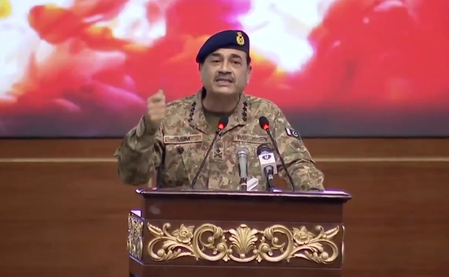
Washington: By any measure, Pakistan’s Chief of Army Staff, Field Marshal Asim Munir, has crossed a diplomatic red line. Standing on American soil during his second visit to the United States in as many months, Munir delivered a barely veiled nuclear threat against India. He bluntly warned that should Pakistan feel threatened, even by something as seemingly technical as Indian hydropower projects on the Indus River and its tributaries, it would be prepared to plunge South Asia into nuclear conflict.
“We are a nuclear nation,” Munir reportedly said at a US military event in Tempa, Florida, to mark the change of command at US Central Command (CENTCOM) on August 8. “If we think we are going down, we’ll take half the world down with us… We will wait for India to build a dam, and when it does so, phir 10 missile sey faarigh kar dengey [we will destroy it with 10 missiles]… Humein missilon ki kami nahin hai, al-Hamdulillah [we have no shortage of missiles, praise be to God].”
That the chief of Pakistan’s military, who exercises far more real power than the country’s civilian leadership, would make such remarks is troubling enough. That he made them in the United States, at an event tied to the US military’s own Central Command, makes this more than just a regional provocation. It is a moment that demands Washington’s attention, and its response.
To anyone who has watched South Asia’s security politics for decades, Munir’s outburst is not an isolated tantrum. It is part of a well-worn pattern in Pakistan’s strategic toolkit where it uses nuclear brinkmanship to shield and enable lower-intensity proxy warfare, particularly in Kashmir.
This pattern was visible before the April 22 Pahalgam massacre, where terrorists killed 26 tourists in Jammu and Kashmir after segregating them based on religion. Few days prior to that attack, Asim Munir intensified his communal propaganda against India by proclaiming that Hindus and Muslims were fundamentally different and therefore incompatible to live together. This insidious call was interpreted a dangerous cue to terror outfits that have long been nourished by Pakistan’s security establishment. For those familiar with the language of Pakistan-sponsored regional militancy, such statements often function as signals, granting implicit sanction for violence while providing plausible deniability for Rawalpindi and Islamabad.
By raising nuclear threats over India’s harnessing of its water resources by proposed hydroelectric projects, Munir is doing more than sabre-rattling. He is creating an atmosphere in which Pakistan’s hand-in-glove relationship with terrorist proxies can operate with the implicit protection of a nuclear umbrella. This is not new, but it is newly dangerous in the current geopolitical climate. If these statements had been made in Rawalpindi or Islamabad, the international community might have responded with routine condemnation and then moved on. But Munir’s choice of venue, which is a US military event, makes this a direct challenge to Washington’s credibility as a responsible leader of global security norms.
It should be noted that the United States has long asserted itself as a champion for nuclear restraint and non-proliferation. For instance, for decades, it has been pressuring Iran into giving up its nuclear programme through implemented sanctions and recently through targeted strikes on Iranian nuclear sites despite Tehran’s claims of its nuclear programme being strictly civilian in nature. For a Pakistani army chief to stand on US soil and openly threaten nuclear war against the partner of the US, all in silence from the US, would be a detriment to decades of American diplomatic juggling. Therefore, it goes beyond simply India-Pakistan relations.
Munir’s remarks also highlight a deeper, more unsettling truth, which is that Pakistan remains one of the few nuclear-armed states where the arsenal is firmly under military control than the civilian government. And with its history of nurturing dozens of terror groups for decades, whom it has recurrently used against its neighbours from Afghanistan to India, this creates a dangerous nexus in which nuclear custody and extremist networks are not institutionally separated.
The risk is not hypothetical. In a crisis, given its history, there is possibility that Pakistan’s military could leverage its nuclear assets not only as a deterrent against India but as a coercive shield for terrorist operations. If the situation in that country were to devolve into a situation characterized by extreme internal instability, whether political or due to radicalization within the military ranks, it could potentially create vulnerabilities that could be exploited by extremist groups, who are increasingly powerful, to gain access to nuclear materials or delivery systems.
When the same chain command that is responsible for nuclear weapons is also a patron of militant groups, the world is right to worry about the potential for catastrophic convergence. Munir’s casual invocation of “10 missiles” over a dam project should not be mistaken for empty bluster. Rather it provides a window into how Pakistan’s military leadership thinks about the utility of its arsenal.
India swiftly condemned Munir’s incendiary remarks, urging the international community to “draw its own conclusions about the irresponsibility inherent in such statements,” which, it noted, “only reinforce long-held doubts over the integrity of nuclear command and control in a state whose military operates in concert with terrorist groups.” The Ministry of External Affairs reiterated that “India will not succumb to nuclear blackmail” and voiced particular regret that such threats were issued “from the soil of a friendly third country.”
The Pahalgam massacre remains a grim reminder of what happens when militant violence is encouraged under the cover of rhetorical hostility. It was not random violence, but targetted messaging. As such, Munir’s nuclear posturing could easily be read as laying the groundwork for similar operations. By inflating a water dispute into an existential threat, he creates both a justification for violence and an implied warning to the international community, which is that any pressure on Pakistan will force it to “go nuclear.” This framing is a strategic trap, which is one that Washington and the broader international community should be careful not to walk into by treating such rhetoric as bluster to be ignored.
The question now is whether the United States will treat this as the provocation it is. Silence will be read in both Islamabad and New Delhi as a tacit acceptance of Munir’s escalation. A measured but firm response would not only reaffirm US commitment to nuclear restraint but also regain trust in India, its strategic partner, after recent differences over trade tariffs. It would also send a clear message to Pakistan’s military establishment that its old playbook of mixing nuclear threats with proxy warfare will not be tolerated on American soil.
Asim Munir’s rhetoric should not be easily dismissed as mere theatrics. Instead, it signifies a mindset that is deeply rooted into the military thinking of Pakistan, where nuclear weapons are not only a last resort deterrent, but a political shield for its sub-conventional warfare through dozens of proxy terrorist groups such as Lashkar-e-Taiba, Jaish-e-Mohammad or Hizbul Mujahideen, particularly against India in Kashmir. The fact that Munir felt he could make these comments in the United States without fear of diplomatic chastening is telling.
The world has seen what happens when dangerous rhetoric is ignored until after the violence begins. And in South Asia, the stakes are even higher especially when Pakistan’s military establishment has shown a willingness to gamble with both terrorism and now threatening nuclear escalation.
–IANS
/as