Radio Brisvaani

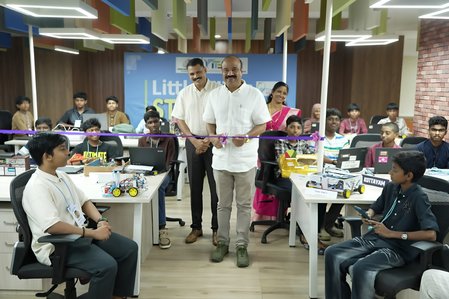
Kochi, April 29 (IANS) Kerala is set to deepen its early lead in school-level digital education by expanding the flagship ‘Little KITES’ IT clubs to cover students from Class 5 to Class 12, bringing the entire public school spectrum under a single, student-led technology network.
The move, announced by KITE CEO K. Anvar Sadath at a state-level camp in Kochi, marks a shift from the programme’s earlier focus on Classes 8-10 to a seamless, pipeline approach to tech learning.
Implemented by Kerala Infrastructure and Technology for Education (KITE), the initiative is already recognised as the country’s largest ICT club network in schools.
Its expansion is expected to significantly widen access to hands-on training in programming, robotics, animation, electronics, and emerging areas such as Artificial Intelligence.
Officials say the redesign aligns with a “learning by doing” framework, aimed at turning students from passive users of technology into creators and problem-solvers.
The scale of participation underscores the programme’s reach.
The ongoing state camp has brought together 204 top students shortlisted from 78,336 applicants across 2,248 school units.
Projects on display reflect a strong social orientation, ‘Robo-Arjun’, an underwater rescue prototype developed by Malappuram students, ‘V-Glove’ translating sign language into speech, and ‘Sonar Pulse’ devices for the visually impaired.
A Malayalam-enabled ‘Care Bot’ designed to assist the elderly with voice commands and medicine reminders further highlights the practical focus.
Beyond hardware innovation, the platform is also nurturing creative digital skills.
Around 50 student-produced animation films screened at the camp engage with themes ranging from environmental conservation to war and space exploration.
The programme’s global connect is reinforced through mentoring sessions led by experts, including Dr Prahlad Vadakkepat of the National University of Singapore and startup ecosystem leaders.
With international recognition, including from UNICEF, Little KITES has emerged as a model for democratising technology education.
Its expansion signals Kerala’s intent to institutionalise innovation from the upper primary level onwards, creating a continuous talent pipeline that could shape the state’s future knowledge economy.
–IANS
sg/dpb